Volume 1
Desiderata curiosa: or, a collection of divers ... pieces relating chiefly to matters of English history : consisting of choice tracts, memoirs, letters ... etc / Transcribed ... and illustrated with ample notes ... By Francis Peck.
- Francis Peck
- Date:
- 1779
Licence: Public Domain Mark
Credit: Desiderata curiosa: or, a collection of divers ... pieces relating chiefly to matters of English history : consisting of choice tracts, memoirs, letters ... etc / Transcribed ... and illustrated with ample notes ... By Francis Peck. Source: Wellcome Collection.
275/298 page 239
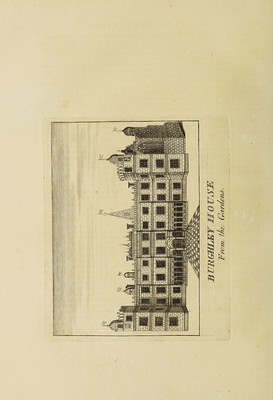
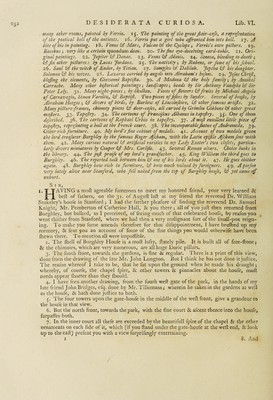
![, was fometimes called the after-mafs, or pod-communion *, becaufe it was always the fird public fervice antiently uled after high-mafs. 3 107. It was fometimes called officium horxfexU, the office of the fixth hour or more brief ly fext. Becaufe antiently the horajexta., or third canonical watch for the day time beean ar our twelve of the clock at noon, & ended at three. 3 ’ ° 108. It was fometimes called, by way of eminence, tempus laudum, the time of praifes or more briefly lauds. Becaufe. it was a fervice containing more anthems h hymns of nraifr t-h™ any other then ufed in the whole courfe of the natural day. ^ 109- And it was fometimes called vigiliarum caput, the head or beginning 0f the watches or more briefly, the vigil; becaule, upon the eve of a fead which had its^ vigil, the recefs* watching & fading relating to that vigil generally began then. 3 * 110. The primitive Chridians borrowed the term vigiliarum caput of the Jews. So the pro¬ phet. In the beginning of the watches pour out thine heart, like water, before the Lord.1 1 11 r. The next watch (beginning at our three of the clock in the afternoon, & endino- at fix) may be called, with the antient Romans, tempuspoftmeridianum, the afternoon, as oppofed to tempus antemeridianum, the forenoon. l 112. The fervice ufed at this part of the day was antiently called, officium bora non<e, the office of the ninth hour; or, more briefly, none. Becaufe antiently the bora nona, or fourth & lad canonical watch for the day time, began at our three of the clock in the afternoon & end¬ ed at flx. 113. Thus I have at length finiffied this brief account of the antient divifions of the night ■& day, as alfo of the antient hours of prayer & the names of each, intermixed with fome other matters of antiquity ; being now got round again to fix of the clock in the evening, the point from whence I at Hrd fet out. In treating upon which I wilh you may not thinkl have been as tirefome to you, as the old monk thought the obfervance of all thefe hours was troublefome to him. 114. c I mud rife,’ fays he,* f at mid-night to go to matins, which continue two hours & an * half. After which I return to my cell, to fee if I can get a little red. About an hour or e two after I am fain to rife again, to go & meditate, & fing that which they call prime. This < done, we are fent to work in a garden, to work & delve for near two hours more; after which ‘ we mud go to fing the terce & high mafs. This done, we go to dinner, which is followed with ' [half] an hour of recreation. The red of the day is taken up in going three times more to * the church, there to fing the vefpers, nones, & complins; fo that we can never have three c quarters of an hour together to our felves,’ [to Jludy.] 115. I have no more to add, except that, if in this attempt I have given any of you learned gentlemen but the lead entertainment, I lhall not think the time I was about it at all ill be¬ llowed. 1. Lament, ii. 19*. 2. Journey to Naples, 8°. Lond. 1691. by G. de E. p. 53. NUMBER XXII.. A’defcrip lion of Burghley Houfe, & of all the principal paintings and other rarities now to befeen there. In a letter to Roger Gale, junr. efq., Pidlura eft poema loquens, mutum pidtura poema. Hon 1. The addrefs. 2. A defeription of the fabric of Burghley houfe in general, 3. In particular, & firft of the fouth front, 't? Mr. Langtons draught of it. 4. Of Mr. Tilleman’s draught of the fiouth weft,view. 5. Of the weft front. 6. North-front. 7. Inner court. 8. If Elizabeth's fpeech to the lord treafurer Burghley, when Jhe came firft' to fee the houfe. 9. Her feat in Burgh¬ ley chappel where. 10. Burghley houfe vaftly improved fince the lord treafurer Burghley's time. dining room', this laft painted by La Guerre. 14. The cielings of the great ft air-cafe, & of many 231-](https://iiif.wellcomecollection.org/image/b3045637x_0001_0275.jp2/full/800%2C/0/default.jpg)