The book of obits and martyrology of the cathedral church of the Holy Trinity, commonly called Christ Church, Dublin / Edited from the original manuscript in the library of Trinity college, Dublin, by John Clarke Crosthwaite ... With an introduction, by James Henthorn Todd.
- Date:
- 1844
Licence: Public Domain Mark
Credit: The book of obits and martyrology of the cathedral church of the Holy Trinity, commonly called Christ Church, Dublin / Edited from the original manuscript in the library of Trinity college, Dublin, by John Clarke Crosthwaite ... With an introduction, by James Henthorn Todd. Source: Wellcome Collection.
66/434
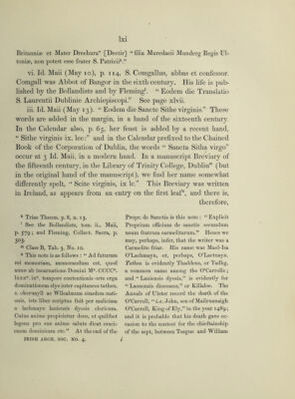
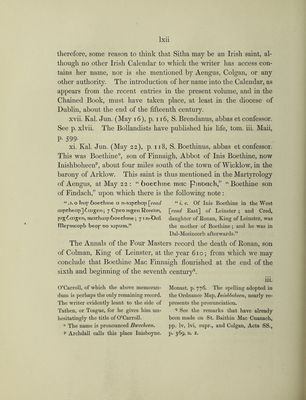
![therefore, some reason to think that Sitha may be an Irish saint, al- though no other Irish Calendar to which the writer has access con- tains her name, nor is she mentioned by Aengus, Colgan, or any other authority. The introduction of her name into the Calendar, as appears from the recent entries in the present volume, and in the Chained Book, must have taken place, at least in the diocese of Dublin, about the end of the fifteenth century. xvii. Kal. Jun. (May 16), p. 116, S. Brendanus, abbas et confessor. See p. xlvii. The Bollandists have published his life, tom. iii. Maii, P- 599- xi. Kal. Jun. (May 22), p. 118, S. Boethinus, abbas et confessor. This was Boethine0, son of Finnaigh, Abbot of Inis Boethine, now Inishboheenp, about four miles south of the town of Wicklow, in the barony of Arklow. This saint is thus mentioned in the Martyrology of Aengus, at May 22 : “ boechine mac pinoach,” “Boethine son of Findach,” upon which there is the following note : “ .1. o Imp &oechine a n-iapchap [read “ i. e. Of Inis Boethine in the West aiptheapjCaijen; 7 CpeDinjen Konain, [read East] of Leinster; and Cred, pijLaijen, machuip 6oednne; 7 1 n-Oal daughter of Eonan, King of Leinster, was ITlepincopb beop 00 iapum.” the mother of Boethine; and he was in Dal-Mesincorb afterwards.” The Annals of the Four Masters record the death of Ivon an, son of Colman, King of Leinster, at the year 610; from which we may conclude that Boethine Mac Finnaigh flourished at the end of the sixth and beginning of the seventh centuryq. iii. O’Carroll, of which the above memoran- Monast. p. 776. The spelling adopted in dum is perhaps the only remaining record, the Ordnance Map, Inishboheen, nearly re- The writer evidently leant to the side of presents the pronunciation. Tathen, or Teague, for he gives him un- q See the remarks that have already hesitatingly the title of O’Carroll. been made on St. Baithin Mac Cuanach, 0 The name is pronounced Bweeheen. pp. lv, lvi, supr., and Colgan, Acta SS.,](https://iiif.wellcomecollection.org/image/b28741523_0066.jp2/full/800%2C/0/default.jpg)