The book of obits and martyrology of the cathedral church of the Holy Trinity, commonly called Christ Church, Dublin / Edited from the original manuscript in the library of Trinity college, Dublin, by John Clarke Crosthwaite ... With an introduction, by James Henthorn Todd.
- Date:
- 1844
Licence: Public Domain Mark
Credit: The book of obits and martyrology of the cathedral church of the Holy Trinity, commonly called Christ Church, Dublin / Edited from the original manuscript in the library of Trinity college, Dublin, by John Clarke Crosthwaite ... With an introduction, by James Henthorn Todd. Source: Wellcome Collection.
97/434
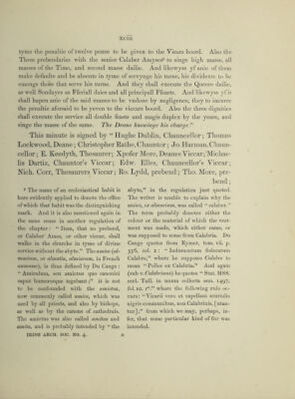
![tyme the penaltie of twelve pence to be given to the Vicars boord. Also the Three prebendaries with the senior Calaber Amysesp to singe high masse, all masses of the Time, and second masse dailie. And likewyse yf anie of them make defaulte and be absente in tyme of servynge his turne, his dividente to be einongs those that serve his turne. And they shall execute the Queere dailie, as well Sondayes as Fferiall daies and all principall Ffeasts. And likewyse yf it shall hapen anie of the said masses to be vndone by negligence, they to incurre the penaltie aforsaid to be yeven to the viccars boord. Also the three dignities shall execute the service all double feasts and magis duplex by the yeare, and singe the masse of the same. The Deane lmowinc/e his cliarcje.” This minute is signed by “ Hughe Dublin, Chauncellor; Thomas Lockwood, Deane; Christopher Rathe, Chauntor; Jo. Harman, Chaun- cellor; E. Keedyth, Thesaurer; Xpofer More, Deanes Viccar ;'Michae- lis Dartiz, Chauntor’s Viccar; Edw. Elies, Chauncellor’s Viccar; Nich. Corr, Thesaurers Viccar; Ro. Lydd, prebend; Tho. More, pre- bend ; p The name of an ecclesiastical habit is here evidently applied to denote the office of which that habit was the distinguishing mark. And it is also mentioned again in the same sense in another regulation of the chapter: “ Item, that no prebend, or Calaber Ames, or other viccar, shall walke in the cliurclie in tyme of divine service without the abyte.” The amice (al- mucium, or almutia, almiacum, in French aumusse), is thus defined by Du Cange : “ Amiculum, seu amictus quo canonici caput humerosque tegebantit is not to be confounded with the amictus. now commonly called amice, which was used by all priests, and also by bishops, as well as by the canons of cathedrals. The amictus was also called amitus and amita, and is probably intended by “ the IRISH ARCH. SOC. NO. 4. ft abyte,” in the regulation just quoted. The writer is unable to explain why the amice, or almucium, was called “ calaber.” The term probably denotes either the colour or the material of which the vest- ment was made, which either came, or was supposed to come from Calabria. Du Cange quotes from Rymer, tom. vii. p. 356, col. 2 : “ Indumentum foderatum Calabre,” where he supposes Calabre to mean “Pelles ex Calabria.” And again (sub v. Calabrinus) he quotes “ Stat. MSS. eccl. Tull, in unum collecta ann. 1497, fol. 10. r°.” where the following rule oc- curs: “Vicarii vero et capellani scuriolis nigris communibus, non Calabrinis, [utan- tur]from which we may, perhaps, in- fer, that some particular kind of fur was intended.](https://iiif.wellcomecollection.org/image/b28741523_0097.jp2/full/800%2C/0/default.jpg)