The mechanical system of uterine pathology : being the Harveian lectures delivered before the Harveian Society of London, December 1877 / by Graily Hewitt.
- Hewitt, Graily, 1828-1893.
- Date:
- 1878
Licence: Public Domain Mark
Credit: The mechanical system of uterine pathology : being the Harveian lectures delivered before the Harveian Society of London, December 1877 / by Graily Hewitt. Source: Wellcome Collection.
71/120 (page 55)
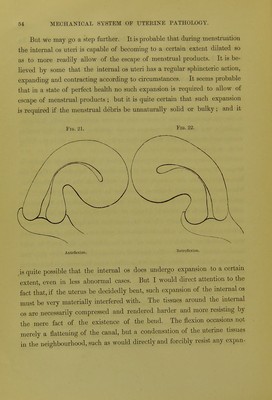
![sion and dilatation of the tube. Other important changes are observed at this situation in consequence of the presence of flexion, but they will be considered later on. The patency of the uterine tube, under ordinary cir- cumstances, is, in short, dependent on the uterus preserving its proper form and thus allowing the canal to remain circular in shape. [The practical closure of the uterine tube by an acute flexion was here illustrated by means of a model of a section of the uterus made in sponge, and six times the normal length of the organ. By bendmg the model section the closure of the canal which thereby ensues was rendered evident.] The connection between obstructed and painful menstruation and con- striction or narrowing of the internal os uteri is one which has been forcing itself on professional attention for some time. But the subject has been imperfectly understood. Stricture of the internal os uteri has been very frequently assumed to be present when the canal was simply very much bent at that point. The condensation and hardening not unfrequently pre- sent around the narrow portion is undoubtedly often great in long-standing cases, and a veritable stricture not seldom exists. But at first it is not so, the canal admitting of easy passage of the sound if the point be only directed properly and in conformity to the bend of the uterus which is present. All cases of dysmenorrhoea are not due to flexion, but the vast majority of them come under this category. There are a few in which the canal is congenitally narrow, or in which obstruction exists at other situa- tions, or in which the obstruction is due to some other condition—a small fibroid tumour growing so as to compress the canal, for instance ; but these cases are rare. The truth of the foregoing statements regarding dysmenorrhcea rests on evidence which seems to be quite unassailable. Chnical facts are most thoroughly and entirely in accordance with this view. Let individual cases be tested, let the uterus be carefully examined, and it will be found that marked dysmenorrhoea will, unless in a very few and exceptional cases, be found associated with undoubted flexion of the uterus. The proof of the](https://iiif.wellcomecollection.org/image/b20389905_0071.jp2/full/800%2C/0/default.jpg)