The origin of some of the streptococci found in milk / by L.A. Rogers and Arnold O. Dahlberg.
- Lore Alford Rogers
- Date:
- 1914
Licence: Public Domain Mark
Credit: The origin of some of the streptococci found in milk / by L.A. Rogers and Arnold O. Dahlberg. Source: Wellcome Collection.
17/28 page 505
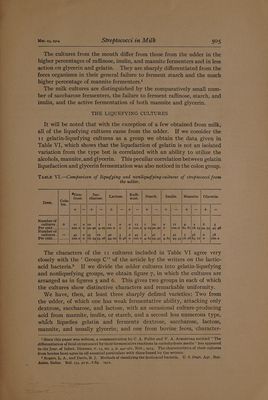
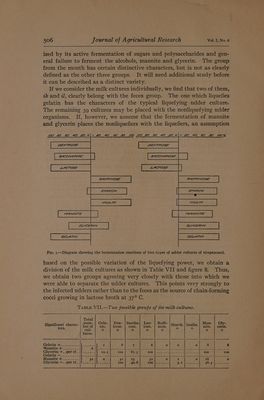
![The cultures from the mouth differ from those from the udder in the higher percentages of raffinose, inulin, and mannite fermenters and in less action on glycerin and gelatin. They are sharply differentiated from the feces organisms in their general failure to ferment starch and the much higher percentage of mannite fermenters.' The milk cultures are distinguished by the comparatively small num- ber of saccharose fermenters, the failure to ferment raffinose, starch, and inulin, and the active fermentation of both mannite and glycerin. THE LIQUEFYING CULTURES It will be noted that with the exception of a few obtained from milk, all of the liquefying cultures came from the udder. If we consider the 11 gelatin-liquefying cultures as a group we obtain the data given in Table VI, which shows that the liquefaction of gelatin is not an isolated variation from the type but is correlated with an ability to utilize the alcohols, mannite,and glycerin. This peculiar correlation between gelatin liquefaction and glycerin fermentation was also noticed in the colon group. TABLE VI.—Comparison of liquefying rie nonliquef ying cultures of streptococci from the udder. SDex- Sac- Raffi- : ; : teocnteal Teharese, Lactose. | 5, eae Starch. Tnulin. | Mannite. | Glycerin. Item Gela- ; tin. Gites tt Sard = Si aa Sin Se BR er ce BS sie — a = Number of cultures .| + Ir | 0 {ro I II ° Oe Len pee ILO ° II 9 2 6 5 Per Cent Cotes. .-.. I00. 0} © |90. 90) 9. 09/100. 0 | oO © |100. 0] 9.09/90.90! 0 =|r00.0 |81. 81/18. 19|54. 54] 45-46 Number of ; cultures .| — 43 ° |33 Io 40 3 ° | 43 2 AI 2 4I 7 36 ° 38 Percents scree 100. o| © |76. Lat 26} 93-02] 6.98] © |100. 0} 4. si ae = 4.65] 95- te 28 83. 72] o 100.0 The characters of the 11 cultures included in Table VI agree very closely with the ‘ Group C”’ of the article by the writers on the lactic- acid bacteria.2 If we divide the udder cultures into gelatin-liquefying and nonliquefying groups, we obtain figure 7, in which the cultures are arranged as in figures 5 and 6. This gives two groups in each of which the cultures show distinctive characters and remarkable uniformity. We have, then, at least three sharply defined varieties: Two from the udder, of which one has weak fermentative ability, attacking only dextrose, saccharose, and lactose, with an occasional culture-producing acid from mannite, inulin, or starch, and a second less numerous type, which liquefies gelatin and ferments dextrose, saccharose, lactose, mannite, and usually glycerin; and one from bovine feces, character- 1 Since this paper was written, a communication by C. A. Fuller and V. A. Armstrong entitled ‘‘ The differentiation of fecal streptococci by their fermentative reactions in carbohydrate media’’ has appeared in the Jour. of Infect. Diseases, v. 13, 00. 3, PD. 442-462, Nov., 1913. The characteristics of their cultures from bovine feces agree in all essential particulars with those found by the writers. 2 Rogers, I,. A., and Davis, B. J. Methods of classifying the lactic-acid bacteria. U.5. Dept. Agr., Bur. Anim. Indus. Bul. 154, 30p., 6 fig. 1912.](https://iiif.wellcomecollection.org/image/b33442642_0017.jp2/full/800%2C/0/default.jpg)
 No text description is available for this image
 No text description is available for this image
 No text description is available for this image