The origin of some of the streptococci found in milk / by L.A. Rogers and Arnold O. Dahlberg.
- Lore Alford Rogers
- Date:
- 1914
Licence: Public Domain Mark
Credit: The origin of some of the streptococci found in milk / by L.A. Rogers and Arnold O. Dahlberg. Source: Wellcome Collection.
22/28 page 510
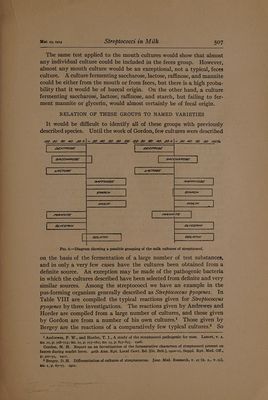
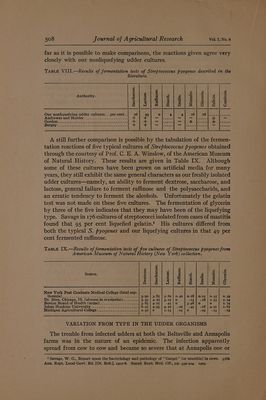
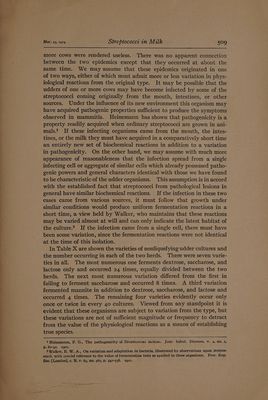
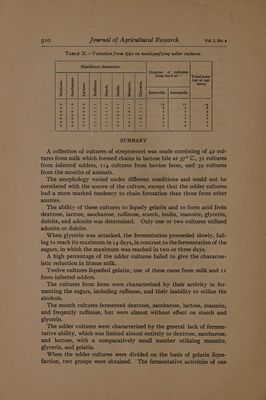
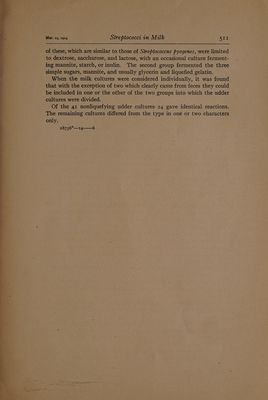
![TaBLeE X.—Variation from type in nonliquefying udder cultures. Significant characters. Number of cultures from herd at— Total num- 3 ber of cul- g g 3 2 f g g tures, glele]e/2/ $i a): 3) a) A lis, 3 3 3 4 & a 3 3 Beltsville nnapo fs ane 4 —s ae 3 —_ Le 12 12 24 + ae + os = = — = 6 2 8 a ire as ae ae Me Ge a Bea I 2 2 4 fe ee eee ee ee ee r : 2 +/+} 4+]—-},-—-{-]-] 4 ° t r + + _ = - - + - bs ° rt +} +]}4+]—-}—-]4]4] - x ° : SUMMARY A collection of cultures of streptococci was made consisting of 42 cul- tures from milk which formed chains in lactose bile at 37° C., 51 cultures from infected udders, 114 cultures from bovine feces, and 39 cultures from the mouths of animals. The morphology varied under different conditions and could not be correlated with the source of the culture, except that the udder cultures had a more marked tendency to chain formation than those from other sources. The ability of these cultures to liquefy gelatin and to form acid from dextrose, lactose, saccharose, raffinose, starch, inulin, mannite, glycerin, dulcite, and adonite was determined. sinh one or two cultures utilized adonite or dulcite. When glycerin was attacked, the fermentation proceeded slowly, fail- ing to reach its maximum in 14 days, in contrast to the fermentation of the sugars, in which the maximum was reached in two or three days. A high percentage of the udder cultures failed to give the character- istic reduction in litmus milk. Twelve cultures liquefied gelatin; one of these came from milk and 11 from infected udders. . The cultures from feces were characterized by their activity in fer- menting the sugars, including raffinose, and their ey to utilize the alcohols. The mouth cultures fermented dextrose, saccharose, lactose, mannite, and freqently raffinose, but were almost without effect on starch and glycerin. The udder cultures were characterized by the general lack of fermen- _ tative ability, which was limited almost entirely to dextrose, saccharose, and lactose, with a comparatively small number utilizing mannite, glycerin, and gelatin. When the udder cultures were divided on the basis of gelatin lique- faction, two groups were obtained. The fermentative activities of one](https://iiif.wellcomecollection.org/image/b33442642_0022.jp2/full/800%2C/0/default.jpg)
 No text description is available for this image
 No text description is available for this image
 No text description is available for this image