[Report 1957] / Medical Officer of Health and School Medical Officer of Health, West Riding of Yorkshire County Council.
- West Riding of Yorkshire (England). County Council
- Date:
- 1957
Licence: Attribution 4.0 International (CC BY 4.0)
Credit: [Report 1957] / Medical Officer of Health and School Medical Officer of Health, West Riding of Yorkshire County Council. Source: Wellcome Collection.
24/184 (page 24)
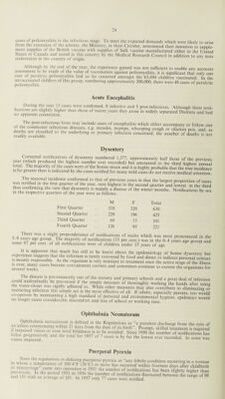
![cases of poliomyelitis in the infectious stage. To meet the expected demands which were likely to arise from the extension of the scheme, the Ministry, in their Circular, announced their intention to supple¬ ment supplies ot the British vaccine with supplies of Salk vaccine manufactured either in the United States or Canada and tested in this country by the Medical Research Council in addition to any tests undertaken in the country of origin. J Although by the end of the year, the experience gained was not sufficient to enable any accurate assessment to be made of the value of vaccination against poliomyelitis, it is significant that only one case of paialytic poliomyelitis had so far occurred amongst the 63,694 children vaccinated In the unvaccinated children of this group, numbering approximately 200.000. there were 48 cases of paralytic poliomyelitis. F y Acute Encephalitis During the year 13 cases were confirmed, 8 infective and 5 post-infectious. Although these noti¬ fications aie slightly higher than those of recent years they arose in widely separated Districts and had no apparent connection. The post-infectious form may include cases of encephalitis which either accompany or follow one con™°ner infectious diseases, e.g. measles, mumps, whooping cough or chicken pox, and, as readily available^ t0 ^ under ying or Pr'marY infection concerned, the number of deaths is not Dysentery Corrected notifications of dysentery numbered 1,377, approximately half those of the previous year (which produced the highest number ever recorded) but amounted to the third highest annual Jitm?u°rity ° Jhe Cafu W?re °f the Sonne strain and ]t is hi§hly probable that the true incidence is tai greater than is indicated by the cases notified for many mild cases do not receive medical attention. The seasonal incidence conformed to that of previous years in that the largest proportion of cases was notified in the first quarter of the year, next highest in the second quarter and lowest in the third thus confirming the view that dysentery is mainly a disease of the winter months. Notifications by sex in the respective quarters of the year were as follows: y ex M F Total First Quarter 310 320 630 Second Quarter 229 196 425 Third Quarter 68 33 101 Fourth Quarter 126 95 221 There was a slight preponderance of notifications of males which was most pronounced in the 5-9 years age group The majority of notifications (33 per cent.) was in the 0-4 years age -roup and some 67 per cent, of all notifications were of children under 15 years of age. P It is apparent that much has still to be learnt about the epidemiology of Sonne dysentery but experience suggests that the infection is rarely conveyed by food and direct or indirect personal contact is mainly responsible. As the organism is very resistant to treatment once the active stage of the illness seven.? weeks beC°me convalescent carriers and sometimes continue to excrete the organisms for disease is pre-eminently one of the nursery and primary schools and a great deal of infection could undoubtedly be prevented if the simple measure of thoroughly washing 'the hands after using restrVt ^r-closet .was rigid 1 y adhered to. While other measures may also contribute to eliminating or restricting infection this simple act is the most effective of all. If adults, especially parents too would co-operate by maintaining a high standard of personal and environmental hygieneP epidemics would 10 lc nger cause considerable discomfort and loss of school or working time. Ophthalmia Neonatorum Ophthalmia neonatorum is defined in the Regulations as “a purulent discharge from the eyes of an infant commencing within 21 days from the date of its birth”. Prompt, skilled treatment is required it impaired vision or even total blindness is to be avoided. Since 1950 the number of notifications has vision impS y t0tal ^ 1957 °f ? CaS£S i$ by far the lowest evei‘ recorded. I none was Puerperal Pyrexia in PyrTia as “any ffbnie condition occurring in a woman nr . • ienff>eratur.e ot 1 4 F (38 C) or more has occurred within fourteen days after childbirth i i . iscai: mge came into operation in 1951 the number of notifications has been slightly higher than ETl Wtfc the Pen°d l9.5?/0,1956 the number of notifications fluctuated between the range of 98 and 151 with an average of 131. In 1957 only 77 cases were notified. 8](https://iiif.wellcomecollection.org/image/b3026330x_0024.jp2/full/800%2C/0/default.jpg)