Volume 1
Catalogue of the Hunterian collection in the Museum of the Royal College of Surgeons in London.
- Royal College of Surgeons of England. Museum
- Date:
- 1830-1831
Licence: Public Domain Mark
Credit: Catalogue of the Hunterian collection in the Museum of the Royal College of Surgeons in London. Source: Wellcome Collection.
104/114 page 92
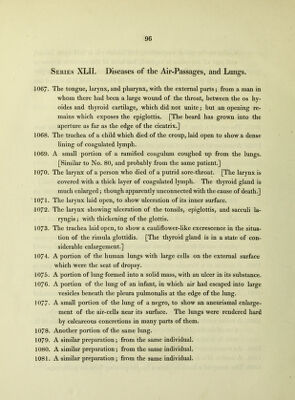
![2. Disease in the Membranes. 1018. A portion of the dura and pia mater of a gentleman. A lamella of coa- gulated lymph is deposited between the two membranes which united them, but they are now partially separated, in order to show the uniting substance more clearly. 1019. A portion of pia mater adhering to the dura mater. [Apparently from the same individual as the preceding preparation.] 1020. A small portion of bone adhering to the outer surface of the dura mater, near the longitudinal sinus. 1021. A portion of the pia mater with its vessels ossified; and adhering to the dura mater. 1022. A portion of pia mater with its vessels ossified. 1023. Arteries of the pia mater ossified. 1024. A portion of dura mater having scrofulous excrescences on both its sur- faces, but especially on the external. 1025. Dura mater with a fungous excrescence upon its external surface, and a similar production on its inner surface, with a portion of the brain ad- hering to it. 1026. An excrescence formed on the inner surface of the dura mater. 1027- A tumour formed on the lower edge of the falciform process of the dura mater. 3. Disease in the Substance of the Brain. 1028. A firm coagulum of blood which was extravasated into the two lateral, the third, and fourth ventricles of the brain. 1029. A section of the brain, showing the cavity of an abscess in the right hemi- sphere of the cerebrum. There appears to be little or no loss of sub- stance of the brain. [From a man who bled to death from an accidental division of the femoral artery. See preparation No. 353.] 1030. Part of the brain of a child which died of hydrocephalus ; showing the septum lucidum stretched, and the two ventricles of the hemispheres so distended as to have made the corpus callosum and the cortical sub- stance of the hemispheres one continued surface ; the falx of the dura mater being absorbed at that part.](https://iiif.wellcomecollection.org/image/b2200662x_0001_0104.jp2/full/800%2C/0/default.jpg)