Volume 1
Catalogue of the Hunterian collection in the Museum of the Royal College of Surgeons in London.
- Royal College of Surgeons of England. Museum
- Date:
- 1830-1831
Licence: Public Domain Mark
Credit: Catalogue of the Hunterian collection in the Museum of the Royal College of Surgeons in London. Source: Wellcome Collection.
105/114 page 93
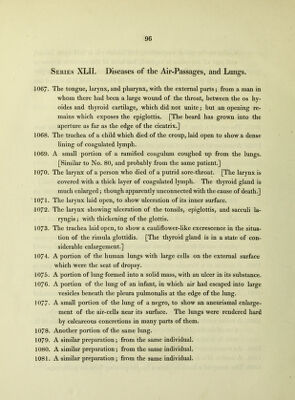
![1031. A section of the cerebellum, to show an uncommon appearance in the medullary substance, marked by a bristle. Series XXXIX. Diseases of the Spinal Chord, and Nerves. 1032. A portion of the medulla spinalis of the neck ; with a coagulum of blood pressing on it, which had been extravasated in consequence of a sub- luxation of the third cervical vertebra. The man had almost complete paralysis of all the [voluntary] parts below the neck ; having only a small degree of tremulous motion in one arm ; and the faeces and urine passed involuntarily. The actions of the vital organs were perfect. In this state the patient lived six weeks. 1033. Vertebrae of the back in a young subject, ulcerated; two of the bodies being nearly destroyed. The medulla spinalis had been compressed in consequence of the incurvation. [A longitudinal section has been made, to show the state of the parts both above and below the part com- pressed.] 1034. A portion of medulla spinalis, from the dorsal region; which had been compressed. 1035. A portion of medulla spinalis, which had been compressed near the origin of the cauda equina. 1036. A small portion of medulla spinalis in which the natural structure is in- distinct. 1037- The carotid artery of a horse, on which, in the extraction of a large tu- mour from the neck, it was necessary to apply a ligature, when the par vagum was also included: the animal became paralysed and died the next evening. The carotid artery, which, while the animal was alive was about half an inch in diameter, was found contracted to less than a quarter, “ which,” Mr. Hunter remarks, “ must have arisen from the “ stimulus of death.” The preparation shows that part of the artery and the nerve which were included in the ligature. [See No. 43/, which is part of the tumour.] 1038. A portion of nerve taken from the stump of the thigh of a man, after](https://iiif.wellcomecollection.org/image/b2200662x_0001_0105.jp2/full/800%2C/0/default.jpg)