Volume 1
Catalogue of the Hunterian collection in the Museum of the Royal College of Surgeons in London.
- Royal College of Surgeons of England. Museum
- Date:
- 1830-1831
Licence: Public Domain Mark
Credit: Catalogue of the Hunterian collection in the Museum of the Royal College of Surgeons in London. Source: Wellcome Collection.
30/114 page 18
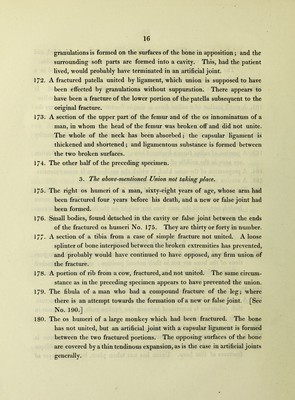
![towards the formation of a false joint; which throws some light on the protracted nature of the case.] 191. A section of a tibia, thickened in consequence of new bone being deposited on its external surface. The newly formed bone is perfectly distinct from the original bone; its fibres are parallel and perpendicular to the surface on which they have been formed. 192. A section of a tibia, showing nearly the same circumstances, in con- sequence of a severe wound. 193. A section of the os femoris of a lion, incrustated over with bone, in con- sequence of ossific inflammation. 2. Exfoliation of Bone. a. Exfoliation from Accident. 194. Part of the femur from a case of compound fracture, the cure of which was retarded in consequence of there being a dead portion of bone to exfoliate. This piece of bone is exposed at the posterior part of the femur; and a fistulous opening communicating with the cavity which contains it, is seen above the inner condyle. [The broken end of the superior portion of the femur is rounded off, apparently preparatory to the formation of a false joint.] 195. The end of a femur on which granulations are forming after amputation. A dead piece of bone may also be seen beginning to exfoliate. 196. The end of the os femoris from a stump after amputation, beginning to exfoliate. [The actual cautery had been applied to its extremity to ac- celerate the process.] b. Exfoliation in consequence of Death being produced by the actual Cautery. 197. A section of the shank-bone of an ass, from which a portion of bone was about to exfoliate. The granulations from the living bone immediately surrounding the dead bone are beginning to ossify. 198. A similar preparation, from which the sequestrum has been removed, ex- posing the cavity from whence the dead piece of bone came. 199. A preparation of the same kind, in which the dead portion of the bone is detached, but remains inclosed in a case of new bone that is formed](https://iiif.wellcomecollection.org/image/b2200662x_0001_0030.jp2/full/800%2C/0/default.jpg)