Volume 1
Catalogue of the Hunterian collection in the Museum of the Royal College of Surgeons in London.
- Royal College of Surgeons of England. Museum
- Date:
- 1830-1831
Licence: Public Domain Mark
Credit: Catalogue of the Hunterian collection in the Museum of the Royal College of Surgeons in London. Source: Wellcome Collection.
42/114 page 30
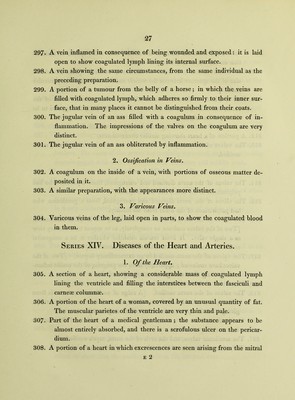
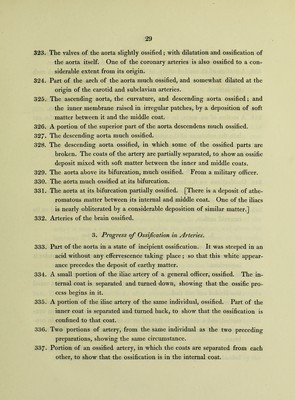
![338. The arch of the aorta much ossified. The inner coat is partially separated, to show that the bony deposit is chiefly confined to that membrane. 339. A portion of an ossified artery, in which the coats are separated from each other, to show that the ossification extends to the other coats as well as the internal. 340. A section of an ossified aorta, the internal membrane of which is turned down, to show that the ossification has extended to the other coats. 341. A section of an aorta, in which are several ossified spots. On the cut edges may be seen the extent of the ossification from the inner surface into the substance of the artery. 342. A similar preparation ; part of the same aorta. 343. The crural artery much corrugated and ossified. 4. Ossification upon Arteries. Ossifications on the external part of the arch of the aorta. From a man who died in consequence of bony deposit in the lungs. [Small ossified spots are also observable on the inner coat.] Another portion of the same aorta, showing osseous matter deposited on its external surface. 5. Obliteration, and Mortification, of Arteries. 346. The umbilical artery of a calf, after its separation from the secundines. The cavity of the artery is filled with coagulated blood, so as to render it impervious. 347. The end of the hypogastric artery of a calf, in a similar state. 348. A coagulum on the end of the crural artery of a boar, in which that vessel was divided and not tied. 349. The carotid artery of an ass, in which that vessel was divided, and the animal allowed to bleed to death. The divided extremities are seen con- tracted, and a coagulum is formed so as to compress the artery, in con- sequence of the diffusion of blood into the surrounding cellular mem- brane. 350. A coagulum in the end of an artery after amputation. A bristle is placed behind the newly formed substance which closes the orifice. 344. 345.](https://iiif.wellcomecollection.org/image/b2200662x_0001_0042.jp2/full/800%2C/0/default.jpg)