Volume 1
Catalogue of the Hunterian collection in the Museum of the Royal College of Surgeons in London.
- Royal College of Surgeons of England. Museum
- Date:
- 1830-1831
Licence: Public Domain Mark
Credit: Catalogue of the Hunterian collection in the Museum of the Royal College of Surgeons in London. Source: Wellcome Collection.
90/114 page 78
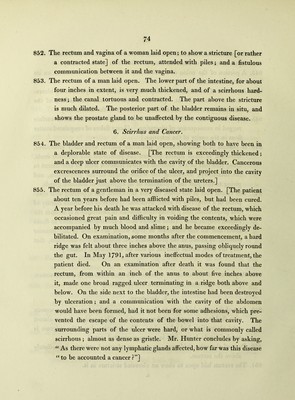
![885. A small hernial sac, laid open, to show the omentum adhering to its inner surface. 886. A hernial sac laid open, to show several very firm adhesions between it and a large portion of omentum which is contained in it. 887- A hernial sac containing omentum. 3. Inguinal Hernia. 888. A hernial sac from a case of inguinal hernia, with the portion of small intestine which had been strangulated: the sac is laid open. The por- tion of intestine which formed the hernia is suspended separate from the sac, and shows that it had burst. [From the appearance of the parts, an operation for relieving the constriction had been performed.] 889. An inguinal hernia complicated with hydrocele. The hernial sac is laid open to show a portion of omentum adhering to its internal surface. The tunica vaginalis is opened on the opposite side of the preparation showing the testicle in situ. 890. The testis, tunica vaginalis, and spermatic chord, in a case of hernia complicated with hydrocele ; and an encysted tumour of the chord. The tumour is seen on the anterior part, above the hydrocele, and the hernia at the upper and posterior part. 891. The sac of an inguinal hernia divided into two cavities by an incomplete transverse septum in the middle. Omentum is contained in both cavities. 4. Congenital Hernia. 892. The sac of a hernia congenita. 893. The tunica vaginalis in a case of hernia congenita, laid open. The hernia is formed by omentum, which is seen in the sac. 5. Femoral Hernia. 894. The parts which constituted a femoral hernia of the right side; from a female patient in St. George’s Hospital. 895. A femoral hernia from a woman. The intestine could not be returned, which occasioned her death. Part of the ilium and epiploon are down. On one side the stricture is exposed.](https://iiif.wellcomecollection.org/image/b2200662x_0001_0090.jp2/full/800%2C/0/default.jpg)