Licence: Public Domain Mark
Credit: Surgery / by John Allan Wyeth. Source: Wellcome Collection.
Provider: This material has been provided by the Augustus C. Long Health Sciences Library at Columbia University and Columbia University Libraries/Information Services, through the Medical Heritage Library. The original may be consulted at the the Augustus C. Long Health Sciences Library at Columbia University and Columbia University.
57/832 (page 45)
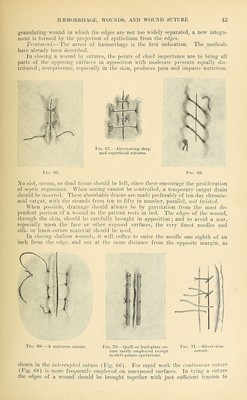
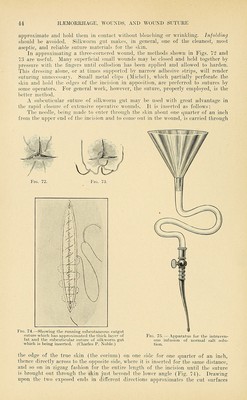
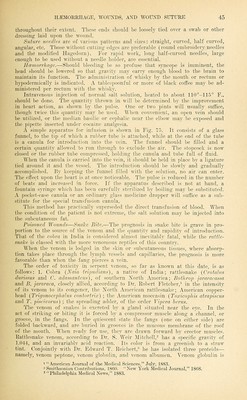
![throughout their extent. These ends should he loosely tied over a swab or other dressing laid upon the wound. Suture needles are of various patterns and sizes: straight, curved, half curved, angular, etc. Those without cutting edges are preferable (round embroidery needles and the modified Hagedorn). For rapid work, long half-curved needles, large enough to be used without a needle holder, are essential. HcemorrJiage.—Should Ijleeding l)e so profuse that sjTicope is imminent, the head should be lowered so that gravity maj^ carry enough blood to the Ijrain to maintain its function. The administration of whisky by the mouth or rectum or hypodermically is indicated. A tablespoonful or more of black coffee may be ad- ministered jDer rectum with the whislr\% Intravenous injection of normal salt solution, heated to about 110°-115° F., should be done. The quantit]^ thrown in will l}e determined by the improvement in heart action, as shown hj the pulse. One or two pints will usuall}' suffice, though twice this quantity nia_y be used. When con-s-enient, an open vein should be utilized, or the median basilic or cephalic near the elbow may be exposed and the pipette inserted under cocaine analgesia. A simjjle apparatus for infusion is shown in Fig. 75. It consists of a glass funnel, to the tip of whicli a ru1)ber tube is attached, while at the end of the tube is a canula for introduction into the vein. The funnel should be filled and a certain quantity allowed to run through to exchide the air. The stopcock is now closed or the rubber titbe compressed, holding the canula and tube full of fluid. When the canula is carried into the vein, it should he held in place by a ligature tied around it and the vessel. The introduction should he slowly and gradually accomplished. By keeping the fttnnel filled with tlie sohition, no air can enter. The effect upon the heart is at once noticeable. The pulse is reduced in the numljer of beats and increased in force. If the apparatus described is not at hand, a fountain syringe which has been carefully sterilized by boiling ma}'^ he substituted. A pocket-case canula or an ordinary glass medicine dropper will suffice as a suId- stitute for the special transfusion canula. This method has jiractically superseded the direct transfusion of blood. When the condition of the patient is not extreme, the salt sohition may be injected into the subcutaneotts fat. Poisoned ^Yonnds—Snalce Bite.—The prognosis in snake bite is grave in pro- portion to the source of the venom and the quantity and rapiditv^ of introduction. That of the cohm in India is considered almost inevitably fatal, while the rattle- snal'e is classed with the more venomous reptiles of this country. \Mten the venom is lodged in the skin or subcutaneous tissues, where absorp- tion takes place through the lymph vessels and capillaries, the prognosis is more favoralile tlian when the fang pierces a vein. The order of toxicit}^ in serpent venom, so far as known at this date, is as follows: 1. Cobra (Naia tripudians), a native of India; rattlesnake (Crofahis durissus and C. adamanteus), of southern Xorth America; Bothrop jararacassa and B. jararaca, closely allied, according to Dr. Eobert Fletcher,^ in the intensity of its venom to its congener, the ?^orth American rattlesnake; American copper- head {TrigonocephaJus contortrix); the American moccasin (Toxicophis atrapiscus and r. piscivorus) ; the spreading adder, of the order Yipera hems. The venom of snakes is excreted by a gland situated near the eye. In the act of striking or biting it is forced by a compressor muscle along a channel, or groove, in the fangs. In the quiescent state the fangs (one on either side) are folded Imckward, and are buried in grooves in the mucous membrane of the roof of the mouth. When ready for use, they are dra'^vn forward by erector muscles. Rattlesnake venom, according to Dr. S. Weir Mitchell,- has a specific gravitv of 1.044, and an invariably acid reaction. Its color is from a greenish to a straw tint. Conjointly with Dr. Edward T. Eeichert,^ he has isolated three proteids— namely, venom peptone, venom glolmlin, and venom albumen. Venom globulin is ' American Journal of the Medical Sciences, July, 1883. 2 Smithsonian Contributions, 1860. New York Medical Journal, 1868. ' Philadelphia Medical News, 1883,](https://iiif.wellcomecollection.org/image/b21203647_0057.jp2/full/800%2C/0/default.jpg)