[Letters to the Water Cure Journal, and other papers, by John Gibbs : being the sequel to "Letters from Graefenberg" / by the same author].
- Gibbs, John, of Camberwell.
- Date:
- 1847-1856
Licence: Public Domain Mark
Credit: [Letters to the Water Cure Journal, and other papers, by John Gibbs : being the sequel to "Letters from Graefenberg" / by the same author]. Source: Wellcome Collection.
134/250 page 122
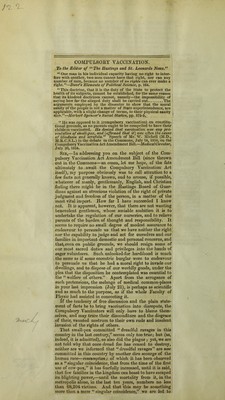
![T. ‘i 1 '7hu*cX , COMPULSOBY VACCINATION. To the Editoi• of “ X/ie Hastings and St. Leonards News.” “ One man in his individual capacity having no right to inter- fere with another, two men cannot have that right, nor can any number of men, because no number of no rights can ever make a right.”—Dove’s Elements of Political Science, p, 164. “ This doctrine, that it is the duty of the State to protect the health of its subjects, cannot be established, for the same reason that its kindred doctrines cannot, namely—the impossibility of saying how far the alleged duty shall be carried out The i arguments employed by the dissenter to show that the moral sanity of the people is not a matter of State superintendence, are applicable, with a slight change of terms, to their physical sanity j also.”—Herbert Spencer’s Social Statics, pp. 373-5, “ He was opposed to it (compulsory vaccination) on constitu- tional grounds, as no parents ought to be compelled to have their children vaccinated. He denied that vaccination was any pre- ventative of sinall-pox, and [affirmed that if] teas often the cause i of blindness and scrofula.” Speech of Mr. W. Michell (M.D., ! M.R.C.S.L.) in the debate in the Commons, July 18, 1S54, on the i Compulsory Vaccination Act Amendment Bill.—Medical Circular, July 26, 1854. Sir,—In addressing you on the subject of the Com- pulsory Vaccination Act Amendment Bill (since thrown i out in the Commons—an omen, let me hope, of the fate ultimately to await the Compulsory Vaccination Act itself), my purpose obviously was to call attention to a few facts not generally known, and to arouse, if possible, whatever of manly, gentlemanly, English, and Christian feeling there might be in the Hastings Board of Guar- dians against an atrocious violation of the right of private judgment and freedom of the person, in a matter of the most vital import. How far I have succeeded I know not. Tt is apparent, however, that there are not wanting benevolent gentlemen, whose amiable ambition it is to undertake the regulation of our nurseries, and to relieve parents of the burden of thought and responsibility. It seems to require no small degree of modest assurance to endeavour to persuade us that we have neither the right nor the capability to judge and act for ourselves and our families in important domestic and personal concerns, and that, even on public grounds, we should resign some of our most sacred duties and privileges into the hands of eager volunteers. Such unlooked-for hardihood is much the same as if some eccentric burglar were to endeavour to persuade us that he had a moral right to invade our dwellings, and to dispose of our worldly goods, under the plea that the disposition he contemplated was essential to the “ welfare of others.” Apart from the arrogance of such pretensions, the melange of medical common-places in your last impression (July 21), is perhaps as scientific and as much to the purpose, as if the whole Faculty of Physic had assisted in concocting it. If the tendency of free discussion and the plain state- ment of facts be to bring vaccination into disrepute, the Compulsory Vaccinators will only have to blame them- selves, and may trace their discomfiture and the disgrace of their, vaunted nostrum to their own rude and insolent invasion of the rights of others. That small-pox committed “ dreadful ravages in this country in the last century,” seems only too true; but (as, indeed, it is admitted), so also did the plague ; yet, we are not told why that once dread foe has ceased to destroy, neither are we informed that “ dreadful ravages” are now committed in this country by another dire scourge of the human race—consumption ; of which it has been observed as a “ singular coincidence, that from the time of the first use of cow-pox,” it has fearfully increased, until it is said, that few families in the kingdom can boast to have escaped its blighting power,—until the mortality from it, in the metropolis alone, in the last ten years, numbers no less than 68,204 victims. And that this may be something more than a mere “ singular coincidence,” we are led to](https://iiif.wellcomecollection.org/image/b28748426_0134.jp2/full/800%2C/0/default.jpg)
 No text description is available for this image
 No text description is available for this image
 No text description is available for this image