[Letters to the Water Cure Journal, and other papers, by John Gibbs : being the sequel to "Letters from Graefenberg" / by the same author].
- Gibbs, John, of Camberwell.
- Date:
- 1847-1856
Licence: Public Domain Mark
Credit: [Letters to the Water Cure Journal, and other papers, by John Gibbs : being the sequel to "Letters from Graefenberg" / by the same author]. Source: Wellcome Collection.
160/250 page 148
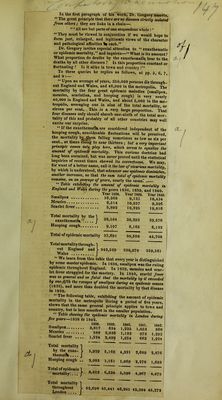
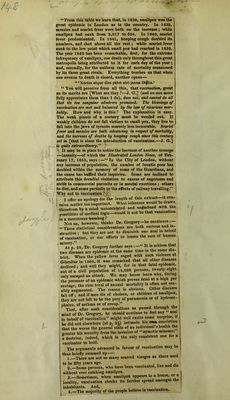
![t l “ From this table we learn that, in 1838, smallpox was the I great epidemic in London as in the country. In 1839, measles and scarlet fever were both on the increase ; while smallpox had sunk from 3,817 to 634. In 1840, scarlet fever predominated. In 1841, hooping cough doubled its numbers, and shot above all the rest; while scarlet fever sunk to the low point which small pox had reached in 1839. The year 1842 has been remarkable, first, for the extreme infrequency of smallpox, one death only throughout this great metropolis being attributed to it for each day of the year ; and, secondly, for the uniform rate of mortality occasioned by its three great rivals. Everything teaches us that when one avenue to death is closed, another opens— “ ‘Noctes atque dies patet atri janua Di^tis.’ “ You will perceive from all this, that vaccination, great as its merits are [What are they ?—J. G.] (and no one more fully appreciates them than 1 do), docs not, and cannot do all that its too sanguine admirers promised. The blessings of vaccination are met and balanced by the law of vicarious mor- tality. How and why is this ? The explanation is easy. The weak plants of a nursery must be weeded out. If weakly children do not fall victims to small pox, they live to fall into the jaws of tyrants scarcely less inexorable. Scarlet fever and measles are both advancing in respect of mortality, and the increase of deaths by hooping cough since this century set in [that is since the introduction of vaccination.—J. G.] is quite extraordinary.” It may be in place to notice the increase of another scourge —insanity—of which the Illustrated London News, of Feb- ruary 17* 1855, says :—“ In the City of London, without any increase of population, the number of lunatic poor has doubled within the memory of some of the Guardians, and the cause has baffled their inquiries. Some are inclined to attribute this dreadful visitation to excess of eagerness and strife in commercial pursuits or in mental exertions ; others to diet, and some partially to the effects of railway travelling.” yhy not to vaccination ? I offer 00 apology for the length of this extract-it con- tains matter too important. What inference would be drawn therefrom by a miud uninoculated and ungmbued with the puerilities of medical logic—would it not be that vaccination is a monstrous humbug ? Not so, however, thinks Dr. Gregory-he continues : — “ These statistical considerations are both curious and in- structive ; but they are not to diminish our zeal in behalf of vaccination, or our efforts to lessen the sum of human m At p. 28, Dr. Gregory further says “ It is seldom that two diseases are epidemic at the same time in the same dis- trict. When the yellow fever raged with such violence at Gibraltar in 1804, it was remarked that all other diseases declined ; and well they might, for in that fatal epidemic, out of a civil population of 14,000 persons, twenty-eight only escaped an attack. We may hence learn why, during the presence of an epidemic which proves fatal at a high per centage, the Sum total of annual mortality is often not sen- sibly augmented. The reason is obvious. Other diseases fall off ; and if men die of cholera, or children of smallpox, they are not left to be the prey of pneumonia or of hydroce- phalus, of asthma or of croup.” That, after such considerations as passed through tbe mind of Dr. Gregory, he should continue to feel any “ zeal in behalf of vaccination” might well excite some surprise, if he did not elsewhere (at p. 2$ intimate his o*h> conviction that the worse the general state of an individual s health the ereater his security from the invasion of “zymotic miasms; t doctrine, indeed, which is the only consistent one for a vaccinator to hold. The arguments advanced in favour of vacciuation may be thus briefly summed up :— 1. There are not so many scarred visages as there used to be fifty years ago. . t , .. ... 2. Some persons, who have been vaccinated, live and die without ever catching smallpox. 3. —Sometimes, when smallpox appears in a house, or a locality, vacciuation checks its further spread amongst the inhabitants. And, . .](https://iiif.wellcomecollection.org/image/b28748426_0160.jp2/full/800%2C/0/default.jpg)
 No text description is available for this image
 No text description is available for this image
 No text description is available for this image