Syntheses in the epinephrine series. Pt. II. [The formation and properties of some 2:5- and 2:6-substituted pyrazines and their conversion into amino-ketones and imino-diketones] / by Frank Tutin.
- Tutin, Frank.
- Date:
- 1910
Licence: Attribution 4.0 International (CC BY 4.0)
Credit: Syntheses in the epinephrine series. Pt. II. [The formation and properties of some 2:5- and 2:6-substituted pyrazines and their conversion into amino-ketones and imino-diketones] / by Frank Tutin. Source: Wellcome Collection.
Provider: This material has been provided by The Royal College of Surgeons of England. The original may be consulted at The Royal College of Surgeons of England.
25/32 page 2517
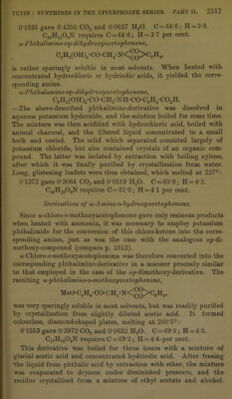
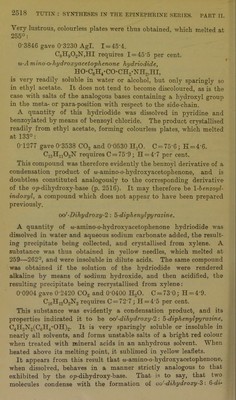
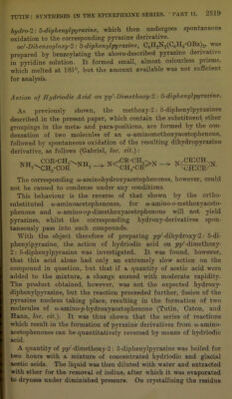
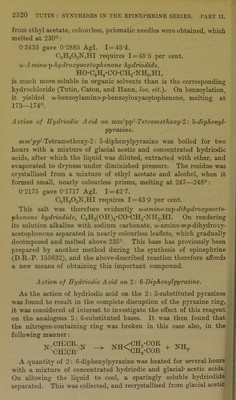
![0'1835 gave 0’4350 C02 and 0’0637 H20. C = 64’6; H = 3'8. C16Hn05N requires C = 646; H = 3'7 per cent. <a-Phthalimino-op-dihy dr oxy acetophenone, C6H3(OH)2*CO-CH2*N<qq>C6H4, is rather sparingly soluble in most solvents. When heated with concentrated hydrochloric or hydriodic acids, it yielded the corre- sponding amine. u-Phthalamino-ov-dihy dr oxy acetophenone, C6H3(0H)2-C0-CH2-NH-C0-CgH4*C02H. —The above-described phthalimino-derivative was dissolved in aqueous potassium hydroxide, and the solution boiled for some time. The mixture was then acidified with hydrochloric acid, boiled with animal charcoal, and the filtered liquid concentrated to a small bulk and cooled. The solid which separated consisted largely of potassium chloride, but also contained crystals of an organic com- pound. The latter was isolated by extraction with boiling xylene, after which it was finally purified by crystallisation from water. Long, glistening leaflets were thus obtained, which melted at 227°: 0-1372 gave 0'3064 CO, and 0’0519 H20. C = 60’9; H = 4‘2. CjgHjgOgN requires C = 610; H = 4T per cent. Derivatives of la-Amino-o-hydroxyacetophenone. Since w-ehloro-o-methoxyacetophenone gave only resinous products when heated with ammonia, it was necessary to employ potassium phthalimide for the conversion of this chloro-ketone into the corre- sponding amine, just as was the case with the analogous op-di- methoxy-compound (compare p. 2512). (u-Chloro-o-methoxyacetophenone was therefore converted into the corresponding phthalimino-derivative in a manner precisely similar to that employed in the case of the op-dimethoxy-derivative. The resulting (a-phthalimino-o-methoxy acetophenone, MeO’C6H4*CO*CH2*N<QQ>C6H4, was very sparingly soluble in most solvents, but was readily purified by crystallisation from slightly diluted acetic acid. It formed colourless, diamond-shaped plates, melting at 200'5°: 0-1553 gave 0'3972 C02 and 0'0632 H20. C = 69'5; H = 45. C17H]304N requires C = 692; H = 44 per cent. This derivative was boiled for three hours with a mixture of glacial acetic acid and concentrated hydriodic acid. After freeing the liquid from phthalic acid by extraction with ether, the mixture was evaporated to dryness under diminished pressure, and the residue crystallised from a mixture of ethyl acetate and alcohol.](https://iiif.wellcomecollection.org/image/b22433168_0027.jp2/full/800%2C/0/default.jpg)