On the naming and classification of mental diseases and defects / by Thomas Laycock.
- Thomas Laycock
- Date:
- 1863
Licence: Public Domain Mark
Credit: On the naming and classification of mental diseases and defects / by Thomas Laycock. Source: Wellcome Collection.
Provider: This material has been provided by The University of Glasgow Library. The original may be consulted at The University of Glasgow Library.
9/34 page 7
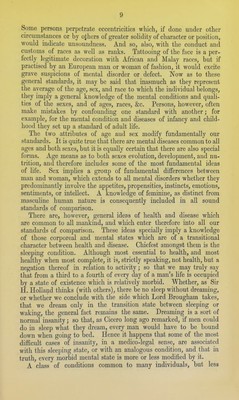
![defects of a science are best sliown, and I think nothing more con- clusively marks the true position of mental science and mental pathology than the confused state of the nomenclature or termi- nology of both, and the serious errors to which it gives origin. Perhaps the best illustration of this statement is to be found in the fact that the highest legal authority of this country, Lord Chancellor Westbury, applied the general term insanity alike to mental dis- orders and mental defects, when legislating on them. Indeed, so little are the nature and value of scientific terms in mental })athology recognised, that by a large and highly educated class of Enghshmeu all the terms which are used by mental physicians to distinguish particular kinds of insanity, such as homicidal, suicidal, and the like, are contemptuously designated '^jargon.' It is plain that nothing less than the most profound ignorance of the subject is implied in this repudiation of technical terms. As to mental diseases, those persons are very much in the position of the infant in relation to men, when it generalises every man under the term papa.^^ If this ignorance of the subject had no bad results, it w^ould require nothing more than a passing smile; but it is, in truth, of great moment to truth and justice, for the same persons who contemp- tuously designate the terms of our art and science as jargon, are also eager to subject insane persons to ignominious punishments, and even to death. We may trace some of this ignorant impatience, how'ever, to prejudices of education, and to the peculiar systems of mental science which have been long current; for wdiile the phraseology of these false or at least insufficient systems has hifected the terminology of medicine with their own faults of vagueness and error, the physiological science of the physician has been too often in conflict with the speculative science of the metaphysician. Too umch has also, perhaps, been expected from science. Eor it must not be concealed that however solidly a system of mental science may be settled, the subject-matter of it offers inherent obstacles to the formation of a satisfactory terminology and classifi- cation. The phenomena to be observed, compared, and classified, are most recondite. Comparison and classification imply that there are sufficient standards with which a thing may be compared, and its resemblances and differences thereby determined. Now, what are the current standards of com])arison hi metaphysics, or mental phy- siology and pathology ? I fear they are at best only vague, general ideas, formed without much regard to scientific accuracy or to these inherent obstacles. It woidd be as difficult to state, in w^ords, what constitutes mental soundness or completeness, as it confessedly is to state what constitutes mental unsoundness or defect. And so soon as we endeavour to fix these standards, we discover that there is a state of existence at which the limits between health and disease vanish, so that the two classes of things to be compared are found](https://iiif.wellcomecollection.org/image/b21481222_0009.jp2/full/800%2C/0/default.jpg)



 No text description is available for this image
 No text description is available for this image
 No text description is available for this image