On the total annual heat received at each point of the Earth's surface from the Sun : and on the amount of the loss of that heat caused by radiation into space (neglecting the effect of the atmosphere) / by Samuel Haughton.
- Samuel Haughton
- Date:
- [1878?]
Licence: Public Domain Mark
Credit: On the total annual heat received at each point of the Earth's surface from the Sun : and on the amount of the loss of that heat caused by radiation into space (neglecting the effect of the atmosphere) / by Samuel Haughton. Source: Wellcome Collection.
Provider: This material has been provided by The Royal College of Surgeons of England. The original may be consulted at The Royal College of Surgeons of England.
3/12
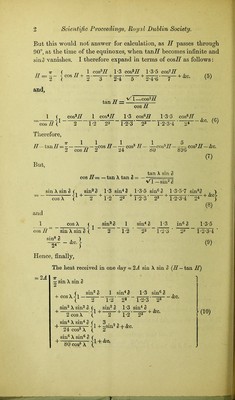
![ON THE TOTAL ANNUAL HEAT RECEIVED AT EACH POINT OF THE EARTH’S SURFACE FROM THE SUN, AND ON THE AMOUNT OF THE LOSS OF THAT HEAT CxVUSED BY RADIATION INTO SPACE (NEGLECTING THE EFFECT OF THE ATMOSPHERE), by THE REV. SAMUEL HAUGIITON, m.d.,dubl.; d.c.l., oxon. The heat received by a given surface at any instant is A cos z dh, where and A = a known constant, z — sun’s zenith distance, A = sun’s ])our angle. y’^Sunrise Total heat received in one day — At cos z dh, %/ Sunset Now, we have cos z = sin A sin S + cos A cos B cos A, where A = latitude of place, S = sun’s declination. If = hour of sunset. (1) Equation (1) thus becomes— Total heat received in one day = / cos z dh A sin A sin Idh + / A cos A cos B cos A dh, ■B J -a = 2 A {sin A sin B ■ cos A cos B sin //}. (2) But, since cos If = — tan A tan B, the expression (2) may be thus written : Total heat received in one day = 2 A sin A sin B {.S’—tan If}. (3) This expression might be expanded by means of Leibnitz’ theorem, as follows: Total heat received in one day = 2 d sin A sin B +■ -4c.) 7 B](https://iiif.wellcomecollection.org/image/b22398077_0005.jp2/full/800%2C/0/default.jpg)