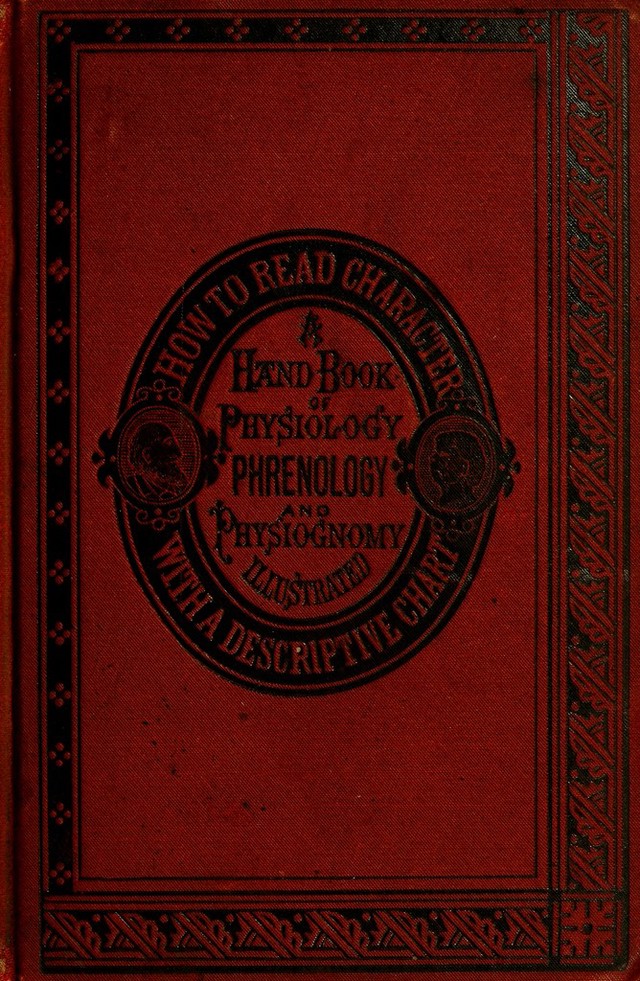
How to read character : a new illustrated hand-book of phrenology and physiognomy, for students and examiners : with a descriptive chart.
- Samuel R. Wells
- Date:
- 1890, ©1868
Licence: Public Domain Mark
Credit: How to read character : a new illustrated hand-book of phrenology and physiognomy, for students and examiners : with a descriptive chart. Source: Wellcome Collection.
Provider: This material has been provided by the Francis A. Countway Library of Medicine, through the Medical Heritage Library. The original may be consulted at the Francis A. Countway Library of Medicine, Harvard Medical School.
144/204 page 138
![of the mind and tlie mind itself. The one must perishj the other we believe will survive and Flourish in immortal yoath. Unliurt amid the war of elements, The wreck of matter, and the crash of worlds. In regard to the asserted fatalistic tendencies of Phrenology, our reply must be mainly the same as in regard to the first part of the objector's statement. If man's constitution of body and brain determine unalterably his character and destiny, so that he can neither be better nor worse than he is, nor in any w^ay different, Phrenology, although it may reveal this character and destiny, is no more responsible for it than theology is for the existence of evil. But while Phre- nology finds mind in this life connected with matter, and subject, so far as its manifestations are concerned, to certain organic laws, it also recognizes wdthin the limits of its organ- izatioi], and as an element in the unalterable law of life, the freedom of the will, and a consequent personal responsibility. We are not res])onsib]e for our being. We are born into this world, made dependent while hero upon material organs for our ability to act, and i-endercd liable to the accidents which happen to matter, and to the final death of the body. In these arrangements Ave had no voice—no freedom to choose Avhen or where we would be born, or how we would be endowed in the matter of body and brain, and therefore can have no responsibility, so far as they are concerned. But there has been bestowed upon us, or rather made a part of our mental constitution, a sense of right and wrong^ and with it the power to choose between good and evil—to rise or to fall—to improve or to deteriorate, and here we are responsible^ not for our faculties, but for the use we make of them. As an additional evidence that Phrenology is in no way inimical to religion, w^e may here mention that it is now embraced and taught by many of the most prominent and truly pious clergymen of Europe and America, including Archbishop Whateley, Thomas Chalmers, D.D., Rev. Orville T)ewey, Rev. John Pierrepont, E. H. Chapip, D.D.- Rev. H^nry ^7ard Beecheii'j aiid jnany others.](https://iiif.wellcomecollection.org/image/b21083824_0144.jp2/full/800%2C/0/default.jpg)