How to read character : a new illustrated hand-book of phrenology and physiognomy, for students and examiners : with a descriptive chart.
- Samuel R. Wells
- Date:
- 1890, ©1868
Licence: Public Domain Mark
Credit: How to read character : a new illustrated hand-book of phrenology and physiognomy, for students and examiners : with a descriptive chart. Source: Wellcome Collection.
Provider: This material has been provided by the Francis A. Countway Library of Medicine, through the Medical Heritage Library. The original may be consulted at the Francis A. Countway Library of Medicine, Harvard Medical School.
158/204 page 152
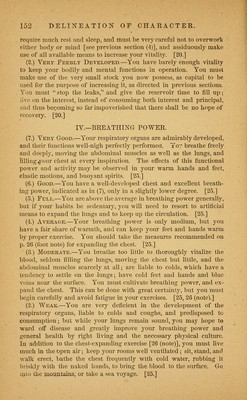
![require mucli rest and sleep, and must be very careful not to overwork either body or mind [see previous section (4)], and assiduously make use of all available means to increase your vitality. [20.] (3.) Very Feebly Developed.—You have barely enough vitality to keep your bodily and mental functions in operation. You must make use of the very small stock you now possess, as capital to be used for the purpose of increasing it, as directed in previous sections. You must stop the leaks, and give the reservoir time to fill up; live on the interest, instead of consuming both interest and principal, and thus becoming so far impoverished that there shall be no hope of recovery. [20.] lY.—BREATHING POWER. (7.) Very Good.—Your respiratory organs are admirably developed, and their functions well-nigh perfectly performed. Yoi breathe freely and deeply, moving the abdominal muscles as well as the lungs, and filling .your chest at every inspiration. The effects of this functional power and activity may be observed in your warm hands and feet, elastic motions, and buoyant spirits. [25.] (6.) Good.—You have a well-developed chest and excellent breath- ing power, indicated as in (7), only in a slightly lower degree. [25.] (5.) Full.—You are above the average in breathing power generall}^ but if your habits be sedentary, you Mill need to resort to artificial means to expand the lungs and to keep up the circulation. [25.] (4.) Average.—Your breathing power is only medium, but you have a fair share of warmth, and can keep your feet and hands warm by proper exercise. You should take the measures recommended on p. 26 (foot note) for expanding the chest. [25.] - (3.) Moderate.—You breathe too little to thoroughly vitalize tlie blood, seldom filling the lungs, moving the chest but little, and the abdominal muscles scarcely at all; are liable to colds, which have a tendency to settle on the lungs; have cold feet and hands and blue veins near the surface. You must cultivate breathing power, and ex- pand the chest. This can be done with great certainty, but you must begin carefully and avoid fatigue in your exercises. [25, 26 (note).] (2.) Weak.—You are veiy deficient in the development of the respiratory organs, liable to colds and coughs, and predisposed to consumption; but while your lungs remain sound, you may hope to ward off disease and greatly improve your breathing power and general health by right living and the necessary physical culture. In addition to the chest-expanding exercise [26 (note)], you must live much in the open air; keep your rooms Avell ventilated; sit, stand, and walk erect, bathe the chest frequently with cold water, rubbing it briskl}'^ with the naked hands, to bring the blood to the surface, Gq mto the mountains, or take a sea voyage. [25.]](https://iiif.wellcomecollection.org/image/b21083824_0158.jp2/full/800%2C/0/default.jpg)