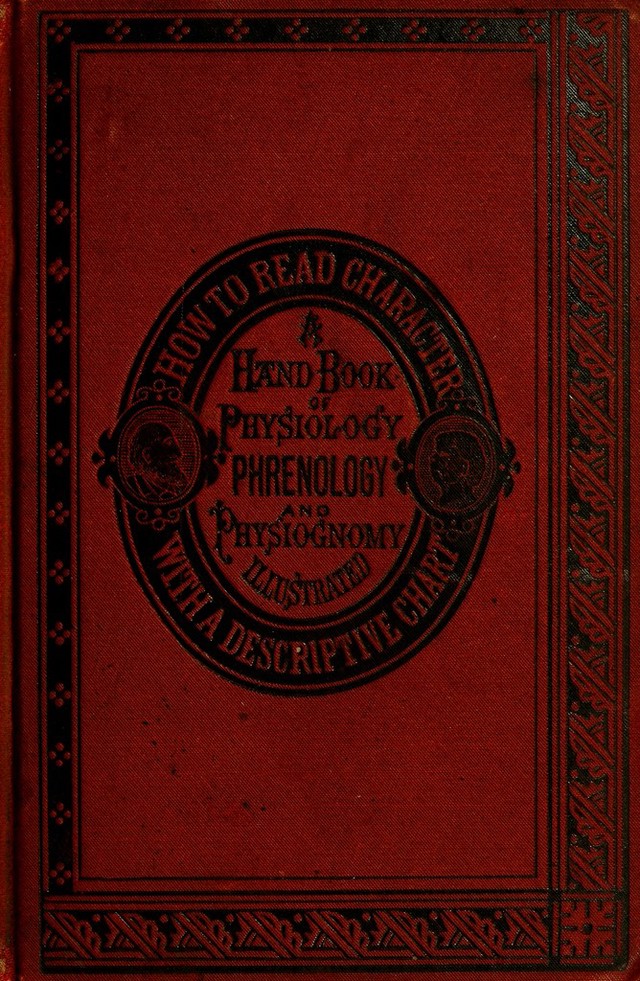
How to read character : a new illustrated hand-book of phrenology and physiognomy, for students and examiners : with a descriptive chart.
- Samuel R. Wells
- Date:
- 1890, ©1868
Licence: Public Domain Mark
Credit: How to read character : a new illustrated hand-book of phrenology and physiognomy, for students and examiners : with a descriptive chart. Source: Wellcome Collection.
Provider: This material has been provided by the Francis A. Countway Library of Medicine, through the Medical Heritage Library. The original may be consulted at the Francis A. Countway Library of Medicine, Harvard Medical School.
21/204 page 15
![tation in a greater or less degree, and must always be taken into account in estimating character. VI. IMPROYABILITY. Every faculty of the human mind is susceptible of being improved by judicious culture. This is a principle of great ]u-actical importance, and affords opportunity and encourage- ment to every one (for all have more or less need of improve- ment), and especially to those who have marked and embar- rassing deficiencies of character. It is only applying to the mind through its organ, the brain, or to a faculty of the mind through its special organ, the same means we make use of to strengthen the arm or increase the flexibility of the fingers— properly adapted exercises. The improvement of man does not imply the extinction of any faculty or the creation of new faculties, but the development and training of all existing mental powers. The means through which each faculty may be strengthened, if too weak or restrained, if too active or influential, will be pointed out in another place. VII. ALL THE FACULTIES GOOD. Each faculty is in itself good, and was given by the Creator for the benefit of its possessor and the world, but may be perverted and distorted, and thus made an instrument of evil, or stunted and dwarfed, so as to become impotent for good. When rightly developed, acting in harmony, and with the lower faculties duly subjected to the higher, each contributes its share to the welfare and happiness of man. There is no organ of murder, but there is a faculty intended to impart energy, executiveness, force and effectiveness in character and action, which, when large, active, and not restrained by the more conservative powers of the mind, may lead to violence and bloodshed. So the property- getting, accumulating propensity, ^iven us for the laudable purpose of making a wise provision for the future, may, by perversion and lack of moral control, become the instigator of fraud and theft. In all cases the evil is the result of a disorderly manifestation, and not the legitimate action of the faculty.](https://iiif.wellcomecollection.org/image/b21083824_0021.jp2/full/800%2C/0/default.jpg)