Volume 2
T. Lucreti Cari De rerum natura libri sex / with notes and a translation by H.A.J. Munro.
- Lucretius
- Date:
- 1900-1910
Licence: In copyright
Credit: T. Lucreti Cari De rerum natura libri sex / with notes and a translation by H.A.J. Munro. Source: Wellcome Collection.
23/316 page 7
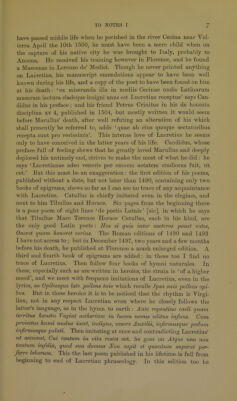
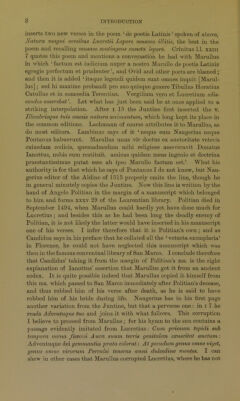
![have passed middle life when he perished in the river Cecina near Vol- terra April the 10th 1500, he must have been a mere child when on the capture of his native city he was brought to Italy, probably to Ancona. He received his training however in Florence, and he found a Maecenas in Lorenzo de' Medici. Though he never printed anything on Lucretius, his manuscripb emendations appear to have been well known during his life, and a copy of the poet to have been found on him at his death: *ex miseranda illa in mediis Cecinae undis Latinarum musarum iactura cladeque insigni unus est Lucretius receptus! says Can- didus in his preface; and his friend Petrus Crinitus in his de honesta disciplina xv 4, published in 1504, but mostly written it would seem before Marullus' death, after well refuting an alteration of his which shall presently be referred to, adds *quae ab eius quoque sectatoribus recepta sunt pro verissimis'. This intense love of Lucretius he seems only to have conceived in the latter years of his life. Candidus, whose preface full of feeling shews that he greatly loved Marullus and deeply deplored his untimely end, strives to make the most of what he did: he says *Lucretianae adeo veneris per omnem aetatem studiosus fuit, ut cet. But this must be an exaggeration: the first edition of his poems, published without a date, but not later than 1490, containing only two books of epigrams, shews so far as I can see no trace of any acquaintance with Lucretius. Catullus is chiefly imitated even in the elegiacs, and next to him Tibullus and Horace. Six pages from the beginning there is à poor poem of eight lines *de poetis Latnis' [sic], in which he says that Tibullus Maro Terence Horace Catullus, each in his kind, are the only good Latin poets: Zos sí qwis inter caeteros ponet vates, Oneret quam, honoret verius. 'The Roman editions of 1490 and 1493 Ihave not access to; butin December 1497, two years and a few months before his death, he published at Florence a much enlarged edition. A third and fourth book of epigrams are added: in these too I find no trace of Lucretius. Then follow four books of hymni naturales. In these, especially such as are written in heroics, the strain is *of a higher mood', and we meet with frequent imitations of Lucretius, even in the lyries, as Opibusque late pollens twis which recalls /psa suis pollens opi- bus. But in these heroies it is to be noticed that the rhythm is Virgi- lian, not in any respect Lucretian even where he closely follows the latter's language, as in the hymn to earth: Ante repentino caeli quam territus. haustu Vagiat aetheriam in. lucem novus editus infans. Cum proiectus humi mudus 4acet, indigus, exsors Aucilii, infirmusque pedum infirmusque palati, Then imitating at once and contradicting Lucretius ut aecumst, Cui tantum n. vita restet cet. he goes on Atque uno non tantwm, infeliz, quod. sua. damna Non. capit. et. quantum. superat per- Jerre laborum, This the last poem published in his lifetime is full from beginning to end of Lucretian phraseology. In this edition too he](https://iiif.wellcomecollection.org/image/b24880164_0002_0023.jp2/full/800%2C/0/default.jpg)
 No text description is available for this image
 No text description is available for this image
 No text description is available for this image