Volume 2
T. Lucreti Cari De rerum natura libri sex / with notes and a translation by H.A.J. Munro.
- Lucretius
- Date:
- 1900-1910
Licence: In copyright
Credit: T. Lucreti Cari De rerum natura libri sex / with notes and a translation by H.A.J. Munro. Source: Wellcome Collection.
30/316 page 14
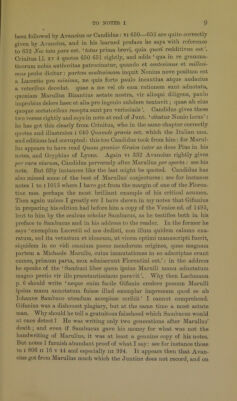
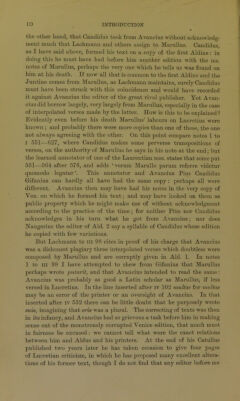
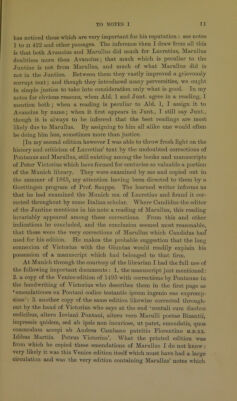
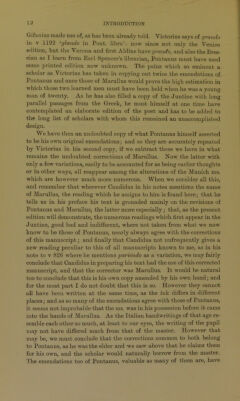
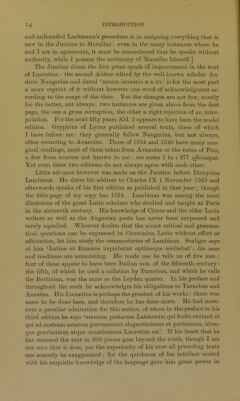
![and unfounded Lachmann's procedure is in assigning everything that is new in the Juntine to Marullus: even in the many instances where he and I are in agreement, it must be remembered that he speaks without authority, while I possess the testimony of Marullus himself.] The Juntine closes the first great epoch of improvement in the text of Lucretius: the second Aldine edited by the well-known scholar An- drew Naugerius and dated * mense ianuario w.p.xv.' is for the most part a mere reprint of it without however one word of acknowledgment ac- cording to the usage of the time. Yet the changes are not few, mostly for the better, not always: two instances are given above from the first page, the one a gross corruption, the other a right rejection of an inter- polation. Forthe next fifty years Ald. 2 appears to have been the model edition. Gryphius of Lyons published several texts, three of which I have before me: they generally follow Naugerius, but not always, often recurring to Avancius. Those of 1534 and 1540 have many mar- ginal readings, most of them taken from A vancius or the notes of Pius, a few from sources not known to me: see notes l1 to 1 977 officiatque. Yet even these two editions do not always agree with each other. Little advance however was made on the Juntine before Dionysius Lambinus. He dates his address to Charles IX 1 November 1563 and afterwards speaks of his first edition as published in that year; though the title-page of my copy has 1564. Lambinus was among the most illustrious of the great Latin scholars who studied and taught at Paris in the sixteenth century. His knowledge of Cicero and the older Latin writers as well as the Augustan poets has never been surpassed and rarely equalled. Whoever doubts that the nicest critical and gramma- tical questions can be expressed in Ciceronian Latin without effort or affectation, let him study the commentaries of Lambinus. Scaliger says of him *Latine et Romane loquebatur optimeque sceribebat!: his ease and readiness are astonishing. He made use he tells us of five mss. : four of these appear to have been Italian mss. of the fifteenth century: the fifth, of which he used a collation by Turnebus, and which he calls the Bertinian, was the same as the Leyden quarto. In his preface and throughout the work he acknowledges his obligations to Turnebus and Auratus. His Lucretius is perhaps the greatest of his works: there was more to be done here, and therefore he has done more. He had more- over a peculiar admiration for this author, of whom in the preface to his third edition he says *omnium poetarum Latinorum qui hodie exstant et qui ad nostram aetatem pervenerunt elegantissimus et purissimus, idem- que gravissimus atque ornatissimus Lucretius est'. If his boast that he has restored the text in 800 places goes beyond the truth, though I am not sure that it does, yet the superiority of his over all preceding texts can scarcely be exaggerated ; for the quickness of his intellect united with his exquisite knowledge of the language gave him great power in](https://iiif.wellcomecollection.org/image/b24880164_0002_0030.jp2/full/800%2C/0/default.jpg)
 No text description is available for this image
 No text description is available for this image
 No text description is available for this image