Volume 2
T. Lucreti Cari De rerum natura libri sex / with notes and a translation by H.A.J. Munro.
- Lucretius
- Date:
- 1900-1910
Licence: In copyright
Credit: T. Lucreti Cari De rerum natura libri sex / with notes and a translation by H.A.J. Munro. Source: Wellcome Collection.
45/316 page 29
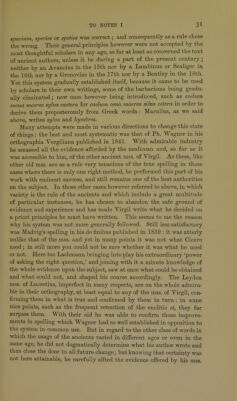
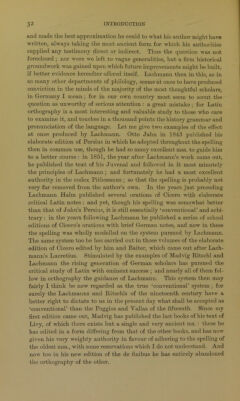
![and unless I err, I have shewn that not a few sections thus marked by him are properly connected with what precedes and follows. Yet it is certain that his theory applies to r1 165—183, and more than one long paragraph of rv v and vr. It has been shewn sufliciently in the notes to these passages that the most important of them have a close connexion in matter and manner with each other. Like Lachmann, I have marked them off by []. All through the poem many single verses and passages of some length are designedly repeated by the poet, some of them again and again. It is probable that he would have removed many of them, if he had lived to revise his work: the exordium of tv for instance could hardly have been left. Some readers may be surprised at the number of verses which have been transposed in the poem; but they should remember that every ancient writing which depends finally on one ms. is in a similar plight. When a scribe omitted by accident a verse, in order not to spoil the look of his book, he wrote it at once after the next verse, if he immediately discovered his error; if not, he omitted it altogether, or added it in some other place, often at the bottom of a page; he would then affix an 4, b to mark the right order; the next scribe would not notice or would purposely omit these and so on: see Bentl. to Hor. ars 46. Every one of these errors has been committed again and again by the copyists of our poem. Most of these transpositions are certain and were made long ago by Lambinus Marullus Avancius and others; many were first made by Lachmann. Some of these I have not followed : not a few I have first ventured on myself. But connected with this question I must draw attention to one point which seems of importance. You would expect as a rule single verses to be thus transposed; and this is the case in Lucre- tius' mss. as in those of other writers: sometimes too one or more verses are repeated after the misplaced verse, which ought to follow it in its proper place, as if to shew the reader whither it ought to be transferred: comp. Iv 991 ie. 999 of the mss. followed in them by 1000—1003, which are only the vss. which follow it in its right place repeated after it in its wrong place: see also v 570 (573) and what comes after. But besides such usual instances of transposition there are throughout the poem many small groups of verses, forming generally sentences complete in themselves, which have got quite out of their right place: comp. 1 984 —987 (998—1001) 1 652—657 (655—659 680) and rv 1227 1228 (1225 1226), three passages first transposed by me ; also 11 1139— 1142, 1168—1170, r1 686—690, rv 50—52, v 174 175, 1127 1128. Now that a scribe should so often transpose several consecutive verses always forming an entire and independent sentence by mere casual carelessness, is to me in the highest degreeimprobable, Again most of these passages read to me like possible additions not necessary to the context, though they improve it. I believe them then to be marginal additions by the](https://iiif.wellcomecollection.org/image/b24880164_0002_0045.jp2/full/800%2C/0/default.jpg)
 No text description is available for this image
 No text description is available for this image
 No text description is available for this image