Volume 2
T. Lucreti Cari De rerum natura libri sex / with notes and a translation by H.A.J. Munro.
- Lucretius
- Date:
- 1900-1910
Licence: In copyright
Credit: T. Lucreti Cari De rerum natura libri sex / with notes and a translation by H.A.J. Munro. Source: Wellcome Collection.
54/316 page 38
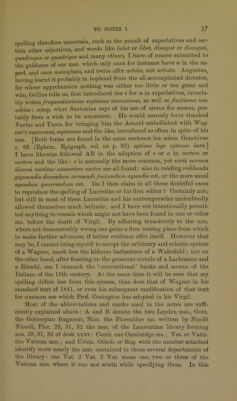
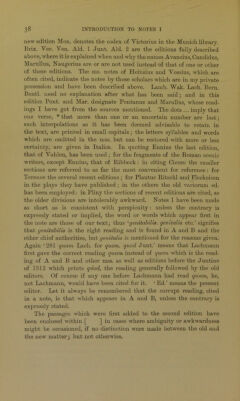
![new edition Mon. denotes the codex of Victorius in the Munich library. Brix. Ver. Ven. Ald. 1 Junt. Ald. 2 are the editions fully described above, where it is explained when and why the names A vancius, Candidus, Marullus, Naugerius are or are not used instead of that of one or other of these editions. 'The ms. notes of Heinsius and Vossius, which are often cited, indicate the notes by those scholars which are in my private possession and have been described above. Lamb. Wak. Lach. Bern. Bentl. need no explanation after what has been said; and in this edition Pont. and Mar. designate Pontanus and Marullus, whose read- ings I have got from the sources mentioned. The dots ...imply that one verse, *that more than one or an uncertain number are lost; such interpolations as it has been deemed advisable to retain in the text, are printed in small capitals; the letters syllables and words which are omitted in the mss. but can be restored with more or less certainty, are given in Italies. In quoting Ennius the last edition, that of Vahlen, has been used ; for the fragments of the Roman scenic writers, except Ennius, that of Ribbeck: in citing Cicero the smaller sections are referred to as far the most convenient for reference: for Terence the several recent editions; for Plautus Ritschl and Fleckeisen in the plays they have published; in the others the old variorum ed. has been employed: in Pliny the sections of recent editions are cited, as the older divisions are intolerably awkward. Notes l have been made as short as is consistent with perspicuity: unless the contrary is expressly stated or implied, the word or words which appear first in the note are those of our text; thus 'genitabilis. genitalis etc. signifies that genitabilis is the right reading and is found in A and B and the other chief authorities, but genitalis is mentioned for the reasons given. Again *281 quam Lach. for quem. quod Junt. means that Lachmann first gave the correct reading quam instead of quem. which is the read- ing of A and B and other mss. as well as editions before the Juntine of 1512 which prints g4/od, the reading generally followed by the old editors. Of course if any one before Lachmann had read quam, he, not Lachmann, would have been cited for it. * Ed.' means the present editor. Let it always be remembered that the corrupt reading, cited in a note, is that which appears in .A and DB, unless the contrary is expressly stated. The passages which were first added to the second edition have been enclosed within [ ] in eases where ambiguity or awkwardness might be occasioned, if no distinction were made between the old and the new matter; but not otherwise.](https://iiif.wellcomecollection.org/image/b24880164_0002_0054.jp2/full/800%2C/0/default.jpg)
 No text description is available for this image
 No text description is available for this image
 No text description is available for this image