The localisation of cerebral disease : being the Gulstonian lectures of the Royal College of Physicians for 1878 / by David Ferrier.
- David Ferrier
- Date:
- 1878
Licence: Public Domain Mark
Credit: The localisation of cerebral disease : being the Gulstonian lectures of the Royal College of Physicians for 1878 / by David Ferrier. Source: Wellcome Collection.
Provider: This material has been provided by the University of Massachusetts Medical School, Lamar Soutter Library, through the Medical Heritage Library. The original may be consulted at the Lamar Soutter Library at the University of Massachusetts Medical School.
126/164 (page 110)
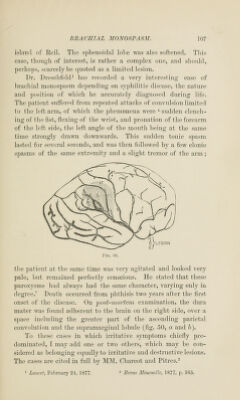
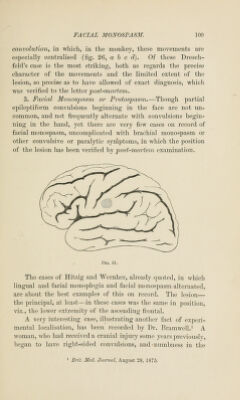
![thumb and forefinger, followed by paralysis of the right arm and leg. She remained subject to frequently repeated convul- sions, which always began in the right platysma, and frequently were almost entirely confined to this muscle. On 'post- mortem examination, a spiculum of bone was found project- ing from the inner table of the skull, and causing a very limited lesion of the inferior margin of the ascending parietal convolution (fig. 51). A reference to the figure of the brain of the monkey (fig. 26, [11]) will show that at the lower extremity of this convolution, and just posterior to the oral and lingual centres, there is an area marked off, irritation of which specially causes action of this muscle. Bramwell's case receives its explanation from this fact, and in Dreschfeld's case, in which spasm of the platysma was also a special feature, the lesion affected this point. Pathology and physiological experiment are here again in harmony. B.—Lesions of the Sensory Eegions. I would now call your attention to the subject of lesions of the sensory regions of the cerebral hemispheres. That the cerebral hemispheres are the seat of sensation or— in order to avoid disputes as to the meaning of sensation—of sensory perception, is abundantly evident both from the results of experimental physiology and from the facts of clinical medi- cine. And that the regions of the brain we have already con- sidered, viz., the fronto-parietal regions, may be disorganised without causing loss of sensory perception, I consider to be de- monstrated both by the facts of experiments on monkeys, and by the clinical evidence which I have laid before you. Some statements which have been made to the contrary, based on experiments on dogs and rabbits, are, as I hope to be able to show you, susceptible of a totally different interpretation, and one in harmony with the facts relating to monkeys and man. It is clear, therefore, that if the centres of sensory percep- tion are localised in the hemispheres—and this, I think, no one will dispute—they are to be sought for in those regions yet remaining to be considered, viz., the occipital and parieto-](https://iiif.wellcomecollection.org/image/b21197477_0126.jp2/full/800%2C/0/default.jpg)