The chemistry of nerve-degeneration / by F.W. Mott and W.D. Halliburton.
- Frederick Walker Mott
- Date:
- 1901
Licence: In copyright
Credit: The chemistry of nerve-degeneration / by F.W. Mott and W.D. Halliburton. Source: Wellcome Collection.
Provider: This material has been provided by The Royal College of Surgeons of England. The original may be consulted at The Royal College of Surgeons of England.
13/34 page 447
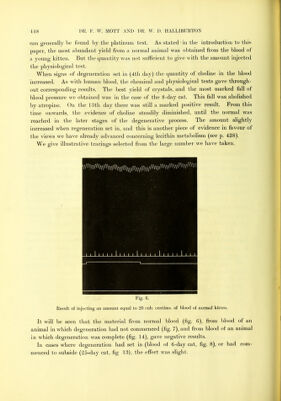
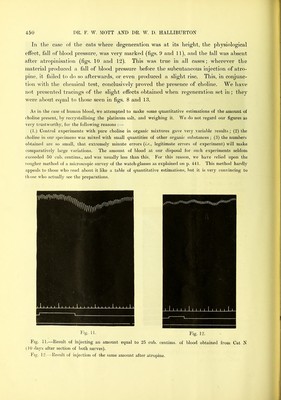
![The left (sutured) nerve responded to stimulation (secondary coil at 7 5 centims.); the right nerve did not respond. Examination of the left nerve showed early signs of regeneration ; the right did not. We, however, found it difficult at this stage, or even in Cat S (60 days after operation) to trace axis cylinders actually through the cicatricial tissue at the junction, although by the Stroebe method axis cylinders were found in the peripheral stump. A chemical examination of these nerves was unfortunately omitted. Cal S.—Both nerves divided. This animal was killed 60 days after the operation. The right nerve had not joined up well; the left not at all. The right nerve responded to stimulation (secondary coil at 9); the left did not. The evidence of regeneration was not so manifest as in the last case, and the products of degeneration had not undergone so much absorption. This animal displayed much lethargy, and was ill nourished as if it lacked vital reaction. Cat I.—Both nerves divided. This animal was killed 100 days after the operation. Cat F.—Both nerves divided. This animal was killed 106 days after the operation. In these two last cats (I and F), though the hind limbs were still thin, there was great recovery of function. The nerves responded well to both mechanical and elect]-ical stimulation (secondary coil at 16 to 18 centims.). The nerves, especially the sensory ones, showed well-marked regeneration, and chemically they had returned approximately to the normal state. We may briefly summarise the results in the following way. Up to the 3rd day the nerves remained excitable and approximately normal. Degenerative changes then set in and became well marked on the 8th day; from this time to the 13th day they were at their height. On the 25th day, and at periods later than this, union of the divided nerves had nearly always taken place. The 29th day marks the entire disappearance of phosphorus from the degenerated fat. Absorption and removal of the fat was nearly accomplished by the 44th day. At the same period restoration of function began in the case of a sutui-ed nerve; but where the nerves had not been sutured this was not seen until the 60th day. In the cats which were allowed to live 100 days and longer, regeneration and restoration of function were well marked. A point of some interest is the early date (44-45 days) at which the removal of degenerated products occurs in peripheral parts of the nervous system. In this there is a contrast to the central nervous system; there the March! reaction can be obtained in degenerated tracts many months after the lesion has occurred. We have now to present the further experiments we have performed in connection with these animals; they divide themselves into three sets, A. Experiments with the blood. B. Chemical examination of the nerves. C. Histological examination of the nerves. We will take these three points in the order named. A. Experiments ivith the Blood of the Cats. These may be very briefly stated. The methods adopted were the same as those already described in connection with human blood. The blood of normal cats contains the merest traces of choline, A few crystals](https://iiif.wellcomecollection.org/image/b22392683_0015.jp2/full/800%2C/0/default.jpg)




 No text description is available for this image
 No text description is available for this image
 No text description is available for this image