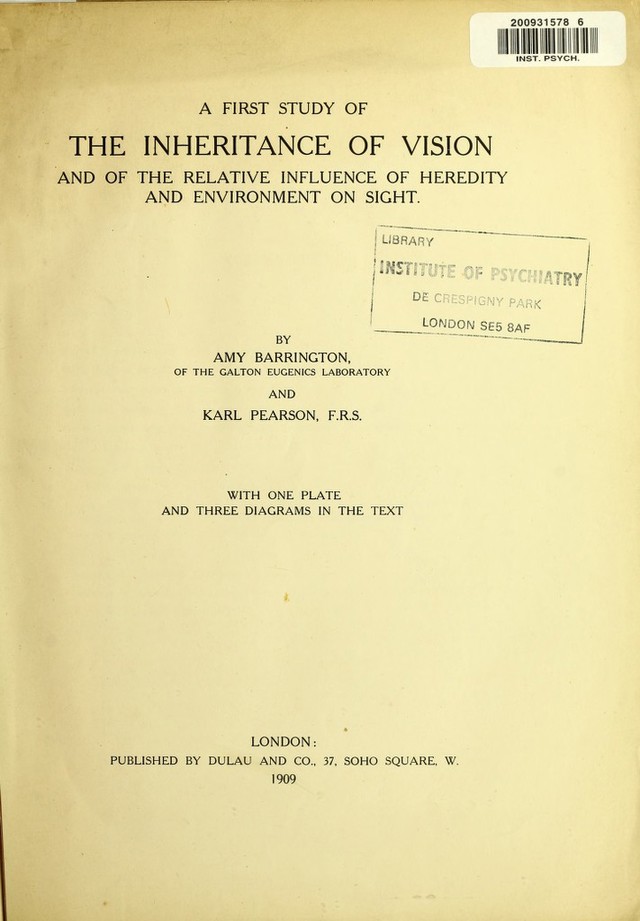
A first study of the inheritance of vision and of the relative influence of heredity and environment on sight / by Amy Barrington and Karl Pearson.
- Barrington, Amy.
- Date:
- 1909
Licence: In copyright
Credit: A first study of the inheritance of vision and of the relative influence of heredity and environment on sight / by Amy Barrington and Karl Pearson. Source: Wellcome Collection.
Provider: This material has been provided by King’s College London. The original may be consulted at King’s College London.
8/74 page 2
![of visual characters. This must be sought for in two directions : vision of the adult and vision of the child. While much information as to the latter can be gained from the reports of medical officers of schools, we must trust for the former to the work of the ophthalmic surgeon in hospital or private practice. The most complete statistical results that we have found from this side are due to Dr Adolf Steiger of Zlirich. In 1895 he published : (A) Beitrdge zur Physiologie und Pathologic der Hornhautrefraction. 1. Theil (Wiesbaden, Bergmann), and in 1906-7 a memoir : (B) Studien uber die erhlichen Verhdltnisse der Hornhautkrummung in Kuhnt and Mechel's Zeitschrift fiir Augenheilkunde, Bd. xvi. S. 229-42, S. 333-59, Bd. XVII. S. 307-17, 444-59. Steiger in his memoir goes so far in modern statistical methods as to give correlation tables and even fourfold tables and uses them to insist in a general way on the inheritance of corneal refraction. He has not, however, applied modern notions of correlation, and his methods of grouping are occasionally such as to give considerable trouble to the statistical investigator. At the very outset also we are encountered by the difficulty that his material is intensely selected. The normal individual is most inadequately represented, because in most cases one or other member of the related pair came to the ophthalmic surgeon on account of defective vision. This statement is not made in order to detract from the great merit of Steiger's work, but to guide our judgment in forming conclusions when we come to interpret the statistical constants. Indeed the fact that Steiger's materia] for adults is not a random sample of the population would we believe be at once admitted by him*. The defect is one which is common to all medically collected data, and we can only place against it the greater accuracy attained by a prolonged and careful examination of the individual by a first class specialist. Unfortunately we have in this case no means of supplementing Steiger's material by a general knowledge of the distribution of astigmatism and corneal refraction in the community at large. We must simply recognise that we are dealing with heredity in highly selected material. Steiger deals not only with material from his private practice, but with observa- tions of Swiss school children. With regard to school children elsewhere the reports we have used are : (C) Errors of Refractio7i among Children attending Elementary Schools in London. By A. Hugh Thompson, M.A., M.D. (London, Bale, reprinted from the British Medical Journal.) Dr Thompson's conclusions as to the influence of age on refraction and astig- matism may be correct, but they are not demonstrated by the statistical method he has employed. He has found that among children of defective vision, the relative * Mein Material wurde eben nicht zu dem ausgesprochenen Zwecke gesammelt, die hereditaren Verhaltnisse zu studiren, (B) Vol. xvii. p. 454.](https://iiif.wellcomecollection.org/image/b21295918_0008.jp2/full/800%2C/0/default.jpg)


 No text description is available for this image
 No text description is available for this image
 No text description is available for this image