The common nature of epidemics, and their relation to climate and civilization, also remarks on contagion and quarantine : from writings and official reports / by Southwood Smith ; ed. by T. Baker.
- Thomas Southwood Smith
- Date:
- 1866
Licence: Public Domain Mark
Credit: The common nature of epidemics, and their relation to climate and civilization, also remarks on contagion and quarantine : from writings and official reports / by Southwood Smith ; ed. by T. Baker. Source: Wellcome Collection.
Provider: This material has been provided by the Francis A. Countway Library of Medicine, through the Medical Heritage Library. The original may be consulted at the Francis A. Countway Library of Medicine, Harvard Medical School.
113/144 (page 103)
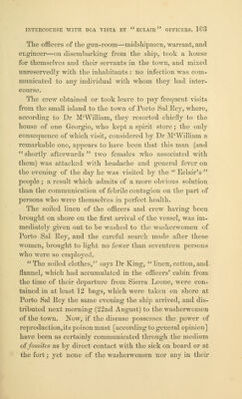
![The officers of tlie gun-room—midsliipmen^ warranty and engineer—on disembarking from tlie ship^ took a house for themselves and their servants in the town, and mixed unreservedly with the inhabitants : no infection was com- municated to any individual with whom they had inter- course. The crew obtained or took leave to pay frequent visits from the small island to the town of Porto Sal Eey^ where^ according to Dr MWilliam_, they resorted chiefly to the house of one Georgio^ who kept a spirit store; the only consequence of which visits considered by Dr MWilliam a remarkable one^ appears to have been that this man (and ^' shortly afterwards '' two females who associated with them) was attacked with headache and general fever on the evening of the day he was visited by the '' Eclair^s '^ people; a result which admits of a more obvious solution than the communication of febrile contagion on the part of persons who were themselves in perfect health. The soiled linen of the officers and crew having been brought on shore on the first arrival of the vessel^ was im- mediately given out to be washed to the washerwomen of Porto Sal Pey^ and the careful search made after these women_, brought to light no fewer than seventeen persons who were so employed. The soiled clothes/^ says Dr King_, linen^ cotton^ and flannel^ which had accumulated in the officers^ cabin from the time of their departure from Sierra Leone^, were con- tained in at least 12 bags_, which were taken on shore at Porto Sal Eey the same evening the ship arrived, and dis- tributed next morning (22nd August) to the washerwomen of the town. ]S[ow_, if the disease possesses the power of reproduction_,its poison must [according to general opinion] have been as certainly communicated through the medium offomites as by direct contact with the sick on board or at the fort j yet none of the washerwomen nor any in their](https://iiif.wellcomecollection.org/image/b21078397_0113.jp2/full/800%2C/0/default.jpg)