Illustrated lectures on ambulance work / by R. Lawton Roberts.
- Roberts, R. Lawton.
- Date:
- 1886
Licence: Public Domain Mark
Credit: Illustrated lectures on ambulance work / by R. Lawton Roberts. Source: Wellcome Collection.
42/218 page 16
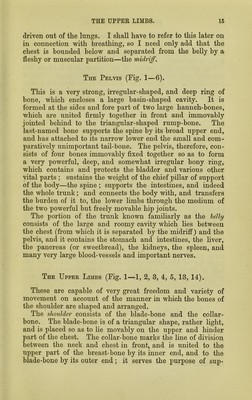
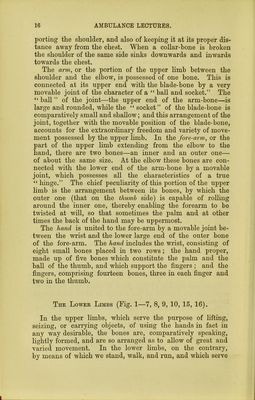
![porting the shoulder, and also of keeping it at its proper dis- tance away from the chest. When a collar-bone is broken the shoulder of the same side sinks downwards and inwards towards the chest. The arm, or the portion of the upper limb between the shoulder and the elbow, is possessed of one bone. This is connected at its upper end with the blade-bone by a very movable joint of the character of a “ ball and sockeL” The “ ball ” of the joint—the upper end of the arm-bone—is large and rounded, while the “socket” of the blade-bone is comparatively small and shallow; and this arrangement of the joint, together with the movable position of the blade-bone, accounts for the extraordinary freedom and variety of move- ment possessed by the upper limb. In the fore-arm, or the part of the upper limb extending from the elbow to the hand, there are two bones—an inner and an outer one— of about the same size. At the elbow these bones are con- nected with the lower end of the arm-bone by a movable joint, which ]possesses all the characteristics of a true “ hinge.” The chief peculiarity of this portion of the upper limb is the arrangement between its bones, by which the outer one (that on the thumb side) is capable of rolling around the inner one, thereby enabling the forearm to be twisted at will, so that sometimes the palm and at other times the back of the hand may be uppermost. The hand is united to the fore-arm by a movable joint be- tween the wrist and the lower large end of the outer bone of the fore-arm. The hand includes the wrist, consisting of eight small bones placed in two rows ; the hand proper, made up of five bones which constitute the palm and the ball of the thumb, and which support the fingers ; and the fingers, comprising fourteen bones, three in each finger and two in the thumb. The Lower Limbs (Fig. 1—7, 8, 9, 10, 15, 16). In the upper limbs, which serve the purpose of lifting, seizing, or carrying objects, of using the hands in fact in any way desirable, the bones are, comparatively speaking, lightly formed, and are so arranged as to allow of great and varied movement. In the lower limbs, on the contrary, by means of which we stand, walk, and run, and which serve](https://iiif.wellcomecollection.org/image/b28074944_0042.jp2/full/800%2C/0/default.jpg)
 No text description is available for this image
 No text description is available for this image
 No text description is available for this image