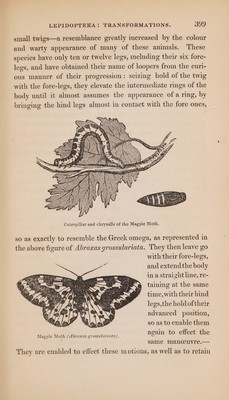
The entomologist's text-book; an introduction to the natural history, structure, physiology and classification of insects, including the Crustacea and Arachnida / By J.O. Westwood.
- John Obadiah Westwood
- Date:
- 1838
Licence: Public Domain Mark
Credit: The entomologist's text-book; an introduction to the natural history, structure, physiology and classification of insects, including the Crustacea and Arachnida / By J.O. Westwood. Source: Wellcome Collection.
432/464 (page 404)
![1. Papilio.—Antennez clavate. A. Equites.—Posterior margin of the wing longer than the anal margin, divided into Trojans, having red spots on the breast, and Greeks, having no spots. B. Heliconit.— Wings narrow, entire, often almost naked. C. Danai.—Wings entire, divided into the Candidi, or whites, and Festivi, or variegated. D. Nymphales.—Wings dentated, divided into the Ocel- lati, or those with eye-like spots, and the Phalerati, or those with simple spots. K. Plebew.—Caterpillars short, thick, divided into the Rurales, or those with dark spots, and the Urbicole, with transparent spots. 2. Sphine.—Antenne prismatic, thickest m the middle. 3. Phalena.—Antenne setaceous, often feathered, divided into A. Attaci—Wings somewhat extended, and inclined at rest. B. Bombyces.—Wings crossed upon the body, antennz pectinated. C. Noctue.—Wings crossed upon the body, antenne setaceous. D. Geometre.—Wings horizontal. Ki. Tortrices.—Wings very obtuse, front margin curved. F. Pyrales—Wings forming with the body a fureate delta. G. Tinee.—Wings rolled into a cylinder. H. Alucite.—Wings digitated. Latreille adopted the Linnean groups, to which he gave the names of—1]. Diwrna (day-fliers); 2. Crepuscularia (twilight-fliers) ; and 3. Nocturna (night-fliers). The Diurna are divisible into the following families :— Fam. 1. Papilionide.—Anterior legs not abbreviated, fit](https://iiif.wellcomecollection.org/image/b33028527_0432.jp2/full/800%2C/0/default.jpg)