The entomologist's text-book; an introduction to the natural history, structure, physiology and classification of insects, including the Crustacea and Arachnida / By J.O. Westwood.
- John Obadiah Westwood
- Date:
- 1838
Licence: Public Domain Mark
Credit: The entomologist's text-book; an introduction to the natural history, structure, physiology and classification of insects, including the Crustacea and Arachnida / By J.O. Westwood. Source: Wellcome Collection.
449/464 (page 421)
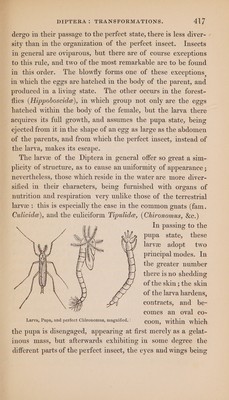
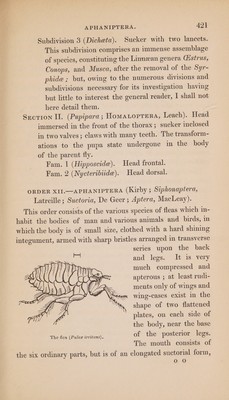
![APHANIPTERA. 42] Subdivision 3 (Dicheta). Sucker with two lancets. This subdivision comprises an immense assemblage of species, constituting the Linnean genera C¥strus, Conops, and Musca, after the removal of the Syr- phide ; but, owing to the numerous divisions and subdivisions necessary for its investigation having but little to interest the general reader, I shall not here detail them. Srcrion II. (Pupipara; HomatopterA, Leach). Head immersed in the front of the thorax; sucker inclosed in two valves; claws with many teeth. The transform- ations to the pupa state undergone im the body of the parent fly. Fam. 1 (Hipposcide). Head frontal. Fam. 2 (Nycteribiide). Head dorsal. ORDER XII.—APHANIPTERA (Kirby ; Siphonaptera, Latreille ; Suctoria, De Geer ; Aptera, MacLeay). This order consists of the various species of fleas which m- habit the bodies of man and various animals and birds, in which the body is of small size, clothed with a hard shining integument, armed with sharp bristles arranged in transverse series upon the back and legs. It is very much compressed and apterous ; at least rudi- ments only of wings and wing-cases exist in the shape of two flattened plates, on each side of the body, near the base of the posterior legs. The mouth consists of the six ordinary parts, but is of an elongated suctorial form,](https://iiif.wellcomecollection.org/image/b33028527_0449.jp2/full/800%2C/0/default.jpg)