Healthy houses : a handbook to the history, defects, and remedies of drainage, ventilation, warming, and kindred subjects : with estimates for the best systems in use, and upward of three hundred illustrations / by William Eassie.
- William Eassie
- Date:
- 1872
Licence: Public Domain Mark
Credit: Healthy houses : a handbook to the history, defects, and remedies of drainage, ventilation, warming, and kindred subjects : with estimates for the best systems in use, and upward of three hundred illustrations / by William Eassie. Source: Wellcome Collection.
Provider: This material has been provided by the Francis A. Countway Library of Medicine, through the Medical Heritage Library. The original may be consulted at the Francis A. Countway Library of Medicine, Harvard Medical School.
26/250 page 14
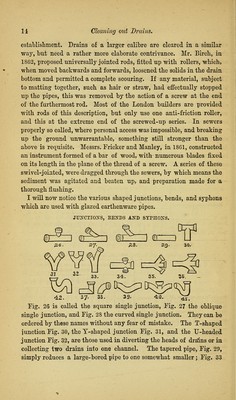
![11 Cleaning out Drains. establishment. Drains of a larger calibre are cleared in a similar way, but need a rather more elaborate contrivance. Mr. Birch, in 1862, proposed universally jointed rods, fitted up with rollers, which, when moved backwards and forwards, loosened the solids in the drain bottom and permitted a complete scouring. If any material, subject to matting together, such as hair or straw, had effectually stopped up the pipes, this was removed by the action of a screw at the end of the furthermost rod. Most of the London builders are provided with rods of this description, but only use one anti-friction roller, and this at the extreme end of the screwed-up series. In sewers properly so called, where personal access was impossible, and breaking up the ground unwarrantable, something still stronger than the above is requisite. Messrs. Fricker and Manley, in 1861, constructed an instrument formed of a bar of wood, with- numerous blades fixed on its length in the plane of the thread of a screw. A series of these swivel-jointed, were dragged through the sewers, by which means the sediment was agitated and beaten up, and preparation made for a thorough flushing. I will now notice the various shaped junctions, bends, and syphons which are used with glazed earthenware pipes. JUNCTIONS, BENDS AND SYPHONS. 0731 @~—] mr^~i @£ I <3 1 Li T&l ^^e^tt^d^ 42. 37- 33. 39. 40. ^ Fig. 26 is called the square single junction, Fig. 27 the oblique single junction, and Fig. 28 the curved single junction. They can be ordered by these names without any fear of mistake. The T-shaped junction Fig. 30, the Y-shaped junction Fig. 31, and the U-headed junction Fig. 32, are those used in diverting the heads of drains or in collecting two drains into one channel. The tapered pipe, Fig. 29, simply reduces a large-bored pipe to one somewhat smaller; Fig. 33](https://iiif.wellcomecollection.org/image/b21050478_0026.jp2/full/800%2C/0/default.jpg)