Cocker's Arithmetick: being a plain and familiar method suitable to the meanest capacity, for the full understanding of that incomparable art, as it is now taught by the ablest school-masters in city and country ... / By Edward Cocker, late practicioner [!] in the arts of writing, artihmetick, and engraving. Being that so long since promised to the world. Perused and published by John Hawkins, writing-master near St. George's church in Southwark, by the author's correct copy, and recommended to the world by many eminent mathematicians and writing-masters in and near London.
- Edward Cocker
- Date:
- 1697
Licence: Public Domain Mark
Credit: Cocker's Arithmetick: being a plain and familiar method suitable to the meanest capacity, for the full understanding of that incomparable art, as it is now taught by the ablest school-masters in city and country ... / By Edward Cocker, late practicioner [!] in the arts of writing, artihmetick, and engraving. Being that so long since promised to the world. Perused and published by John Hawkins, writing-master near St. George's church in Southwark, by the author's correct copy, and recommended to the world by many eminent mathematicians and writing-masters in and near London. Source: Wellcome Collection.
168/234 page 152
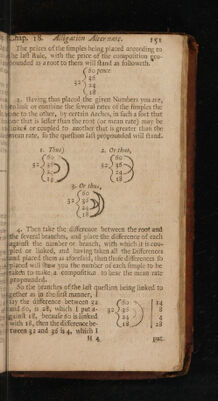
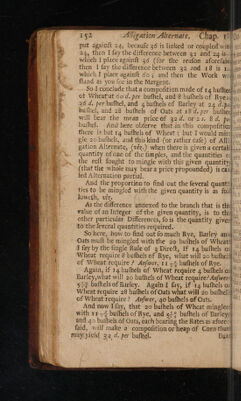
![“« Aliigation Alternate, Chap. 1\! S put againft 24, becaufe 36 is linked or coupled wit 24, then I fay the differenee between 32 and 2q-is- which I place againft 36 (for the reafon aforefaidhy:! then I fay the difference between 32 and 18 is 14s which I place againft 60; and then the Work woril:; fiand as you fee in the Margent. | so-lconciude that a compofition made of 14 buthee) iii ot Wheat-at God. per bufhel, and 8 bufhels of Ryeid, 36d. per bufhel, and 4 buthels of Barley at 24 d. polis: bufhel, and 28 buthels of Oats at 18d. per buffed wii will bear the mean priceof 32d. or 25s. 8d, pod, ;| bufhel. And here obferve that.in this compofitian}; yi there is but 14 bufhels of Wheat 5 but I would mirt},jj 3le 20 bufhels, and this kind (or rather cafe) of Alll]/, ation Alternate, (viz.) when there is given a certaiil «4, quantity of one of the fimples, and the quantities c¢,,,;, the reft fought to mingle with this given quantity) ,, (that the whole may bear a price propounded) is cai), led Alternation partial. And the proportion to find out the feveral quantti}, ties to be mingled withthe given quantity is as fodl},, Joweth, viz. | As the difference annexed to the branch that is thi!’ value of an Integer ofthe given quantity, is to thhi,. other particular Differences, fois the quantity gives} ...’ to the feveral quantities required. | So here, how to find out fo much Rye, Barley anog, Oats muft be mingled with the 20 buthels of Wheatti I fay by the fingle Rule of 3 Dire&, If 14 buthels onj, Wheat require 8 bufhels of Rye, what will 20 bufhebi,”! of Wheat require ? Anfwer, 11 +5 bufhels of Rye. Again, if 14 bufhels of Wheat require 4 bufhels o Earley,what will 20 buthels of Wheat require? Anfwei 574 bufhelsof Barley. Again-I fay, if 14 bufhels o Wheat require 28 bufhels of Oats what will 20 bufhel! of Wheat require? Anfwer, 40 bufhels of Oats. And now I fay, that 20 bufhels of Wheat minglecd with rx ¢ buthels of Rye, and 54° bufthels of Barleyy| and 40 buihels of Oats, each bearing the Rates as afore-4 faid, will make a compofition or heap of Corn thatl] may) yield 32 d, per bufhel. Butth 192 — Ss —— i] 48) Bye ¢ OG aN iy it i, ; wif](https://iiif.wellcomecollection.org/image/b30333878_0168.jp2/full/800%2C/0/default.jpg)