Cocker's Arithmetick: being a plain and familiar method suitable to the meanest capacity, for the full understanding of that incomparable art, as it is now taught by the ablest school-masters in city and country ... / By Edward Cocker, late practicioner [!] in the arts of writing, artihmetick, and engraving. Being that so long since promised to the world. Perused and published by John Hawkins, writing-master near St. George's church in Southwark, by the author's correct copy, and recommended to the world by many eminent mathematicians and writing-masters in and near London.
- Edward Cocker
- Date:
- 1697
Licence: Public Domain Mark
Credit: Cocker's Arithmetick: being a plain and familiar method suitable to the meanest capacity, for the full understanding of that incomparable art, as it is now taught by the ablest school-masters in city and country ... / By Edward Cocker, late practicioner [!] in the arts of writing, artihmetick, and engraving. Being that so long since promised to the world. Perused and published by John Hawkins, writing-master near St. George's church in Southwark, by the author's correct copy, and recommended to the world by many eminent mathematicians and writing-masters in and near London. Source: Wellcome Collection.
178/234 page 162
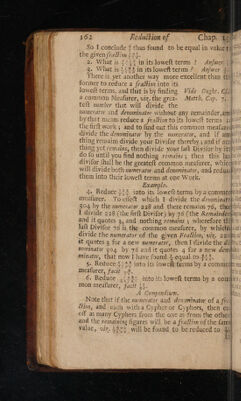
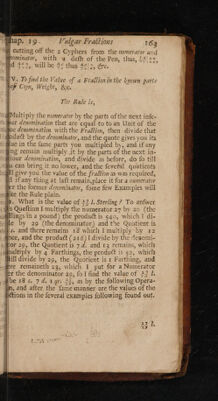
![a So I conclude 7a hus found to be equal in vakue t tii the given fradi On 2 a. What is 22 ae ‘in its loweft terms 2 Anfwer :) 3- What is 1342 in itsloweft terms 2 Anfwer 3. There is yet another way more excellent than th former to reduce a fraéfion into its loweft terms, and that is by finding Vide Ought. C/d| a common Meafurer, viz.the grea- Matth, Cap te{t number that. will divide the auimerator and denominator without any remainder,anny| by that means reducea frzétion to its lowctt terms api the fir! ft work ; ; and to find out this common meafured@' divide the denominator by the numerator, and if amp thing remains divide your Divifor the ireby 5 z and if aq thing a aa then divide your laft Divifor by itt do fo unti | you find nothing remains; then this laaf divifor fhall be the greateft common meafurer, wihriccpil | will divide both numerator. and denominator, and reduced | them into their Loweft terms at one Work. Example. (i 4+ Reduce 32% into its loweft terms by 2 commedt meafurer, To effect which I divide the denominattp’ 304 by the numerator 228 and there remains 76, thea} I divide 228 (the firft Divifor) by 76 (the Remaindeni. and it quotes 3, and nothing remains 5 wherefore thift » Jaft Divifor 76 is the common meafurer, by whichhil: divide the numerator of the siven Fraction, viz. 22m at quotes 3 for a new numerator,, then I divide the dirs; nominator 204 by 76 and it quotes 4 for anew demipili minator, that now I have found 4 equal to py .. q 5° Reduce § fot into 15 iowel terms by a commcatt r 6. Fedice: 28! into its loweft terms by a comrs mon meafurer, facit 13. | Compendium. i Note that if the num erator ai a cs Anbinoag of a fi ion, and each witha C ypher or Cyphers, then cri off as many Cyphers from the one as-from the othes| and the remaining figures will be a fraion of the fancu value, viz. 342° will be found to be reduced to 3i]](https://iiif.wellcomecollection.org/image/b30333878_0178.jp2/full/800%2C/0/default.jpg)