Volume 4
The Health Exhibition literature : Health in diet.
- International Health Exhibition (1884 : London, England)
- Date:
- 1884
Licence: Public Domain Mark
Credit: The Health Exhibition literature : Health in diet. Source: Wellcome Collection.
Provider: This material has been provided by London School of Hygiene & Tropical Medicine Library & Archives Service. The original may be consulted at London School of Hygiene & Tropical Medicine Library & Archives Service.
81/830 (page 73)
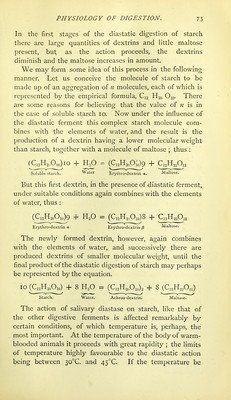
![In the first stages of the diastatic digestion of starch there are large quantities of dextrins and little maltose present, but as the action proceeds, the dextrins diminish and the maltose increases in amount. We may form some idea of this process in the following manner. Let us conceive the molecule of starch to be made up of an aggregation of n molecules, each of which is represented by the empirical formula, C12 H20 Oiq. There are some reasons for believing that the value of n is in the case of soluble starch 10. Now under the influence of the diastatic ferment this complex starch molecule com- bines with the elements of water, and the result is the production of a dextrin having a lower molecular weight than starch, together with a molecule of maltose ; thus : (Ci2H2;)Oio)IO -f- H2O = (C]2H2f,Oio)9 + C12H22O11 Soluble starch. Water Erythro-dextrin a. Maltose. But this first dextrin, in the presence of diastatic ferment, under suitable conditions again combines with the elements of water, thus : (Ci2H2oOxo)9 T H2O = (Ci2H2iiOio)8 1 C12H22O11 Erythro-dextrin a Erythro-dextrin Maltose. The newly formed dextrin, however, again combines with the elements of water, and successively there are produced dextrins of smaller molecular weight, until the final product of the diastatic digestion of starch may perhaps be represented by the equation. 10 (C12H20O10) -j- 8 H2O = (C22H2oOio)2 + 8 (C12H22O11) Starch. Water. Achroo-dextrin. Maltose. The action of salivary diastase on starch, like that of the other digestive ferments is affected remarkably by certain conditions, of which temperature is, perhaps, the most important. At the temperature of the body of warm- blooded animals it proceeds with great rapidity ; the limits of temperature highly favourable to the diastatic action being between 30°C. and 45°C. If the temperature be](https://iiif.wellcomecollection.org/image/b28045282_0001_0081.jp2/full/800%2C/0/default.jpg)