Volume 1
The chemical constitution of the proteins / by R.H.A. Plimmer.
- Robert Plimmer
- Date:
- 1912-1913
Licence: Attribution-NonCommercial 4.0 International (CC BY-NC 4.0)
Credit: The chemical constitution of the proteins / by R.H.A. Plimmer. Source: Wellcome Collection.
162/208 page 146
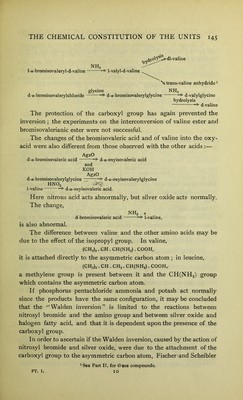
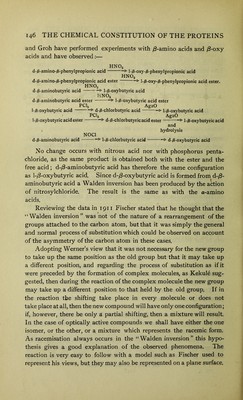
![and Groh have performed experiments with y0-amino acids and y8-oxy acids and have observed :— HNO2 d-/3-amino-)8-phenylpropionic acid > l-jS-oxy-jS-phenylpropionic acid HNO2 d-j8-amino-j8-phenylpropionic acid ester > l-)8-oxy-i8-phenylpropionic acid ester. HNO2 d-j8-aminobutyric acid ^ l-)3-oxybutyric acid HNO2 d-)8-aminobutyric acid ester > l-/8-oxybutyric acid ester PCI5 AgaO 1-0-oxybutyric acid > d-)8-chlorbutyric acid > l-/8-oxybutyric acid PCI5 ^ ^ ^ AgaO ]-/8-oxybutyric acid ester > d-)8-chlorbutyricacid ester > l-)8-oxybutyric acid and ( hydrolysis NOCl d-/3-aminobutyric acid > l-/8-chlorbutyric acid > d-)8-oxybutyric acid No change occurs with nitrous acid nor with phosphorus penta- chloride, as the same product is obtained both with the ester and the free acid; d-y9-aminobutyric acid has therefore the same configuration as l-/3-oxybutyric acid. Since d-^S-oxybutyric acid is formed from d-^- aminobutyric acid a Walden inversion has been produced by the action of nitrosylchloride. The result is the same as with the a-amino acids. Reviewing the data in 1911 Fischer stated that he thought that the “Walden inversion” was not of the nature of a rearrangement of the groups attached to the carbon atom, but that it was simply the general and normal process of substitution which could be observed on account of the asymmetry of the carbon atom in these cases. Adopting Werner’s view that it was not necessary for the new group to take up the same position as the old group but that it may take up a different position, and regarding the process of substitution as if it were preceded by the formation of complex molecules, as Kekule sug- gested, then during the reaction of the complex molecule the new group may take up a different position to that held by the old group. If in the reaction the shifting take place in every molecule or does not take place at all, then the new compound will have only one configuration; if, however, there be only a partial shifting, then a mixture will result. In the case of optically active compounds we shall have either the one isomer, or the other, or a mixture which represents the racemic form. As racemisation always occurs in the “ Walden inversion ” this hypo- thesis gives a good explanation of the observed phenomena. The reaction is very easy to follow with a model such as Fischer used to represent his views, but they may also be represented on a plane surface.](https://iiif.wellcomecollection.org/image/b28123219_0001_0162.jp2/full/800%2C/0/default.jpg)