Training in first aid for civil defence purposes / issued by the Ministry of Home Security in conjunction with the Ministry of Health.
- Date:
- 1942
Licence: Public Domain Mark
Credit: Training in first aid for civil defence purposes / issued by the Ministry of Home Security in conjunction with the Ministry of Health. Source: Wellcome Collection.
25/68 page 23
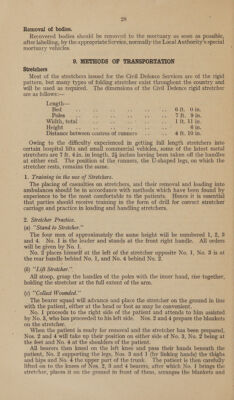
![e (2) To. represent a case suffering from a compound depressed fracture of the skull. In this case good co-operation by the “ casualty’ is very important. He might be discovered lying on his back or side and should pretend to be un- conscious. His face is ‘‘ made up ”’ to appear slightly flushed and his breathing is a little “ snoring.”’ A “ faked ”’ fracture of the skull on the right side about three fingers’ breadth above the ear has been “ built up’ and the legs and arms on the left side of the body (i.e. the side opposite to the fracture) are allowed to go limp to simulate flaccidity. The injuries simulated having been discovered by the pupil, he should proceed to examine the whole body rapidly but thoroughly in order to eliminate the possibility of the presence of other serious injuries, taking care not to touch the wound, or to press on injured bones. He should then proceed to give the appropriate treatment, and to state what would be his decision as to immediate disposal, whether home, to First Aid Post, or to Hospital. The above are examples of what is meant, and others can readily be thought of and set out. The instructor should not volunteer a full statement at the beginning of the examination, but should state appropriate details in reply to definite questions put by the pupil. The pupil during his examination of the case will thus elicit the data he requires for his first aid diagnosis. © 66 Inter Team or Inter Depot Tests and Competitions should be arranged Both in practice and in tests or competitions it will be helpful for the instructor to use detailed marking sheets, which set out each step in the process and allot marks. Simple examples of such itemised marking sheets are given herewith. EXAMPLE I, (a) Information—given by means of a card, or orally by the instructoror judge: “This man has been carried out of a burning building. His hands are burnt; there are no obvious signs of bleeding or fracture. He is unconscious.’ (6) Note for Instructor. Man to be lying on his back. (c) Marking sheet. oe eMCa Gre INO! Vie wi aha Se ly se 2 tn Seat eth ala Ble 2 pivectans Of myury 20 -1ie.chest ( Noy or ea oie 2 eronce wlcercacualty upon his face fs ee eS cae 2 wiitaeamms extended apove tnevHead: =. 4 6) iy he eyes 2 Ete PEC CUO OMCLSIG ot i te a hay al ae 2 so as to keep his nose and mouth away from the ground =—_...... 1 Doe nevwaste tune by Joosenineg clothing... ep el ee he ae 2 To turn on to the face, stoop at his side, place his arms close to IG SOUS 0 tidal ite oS oy Mae Karen eae ee gee eee ns mes ir SUR a hs Okan oer er re te 2 cross his far leg over his near.leg, and, protecting his face with one sta Sn PM ede OO ers nee UR le hao ca 2 with the other grasp his clothing at the hip on the opposite side of the 5 boa dia pullnimn Sinattly Over = ye te ee Bees 2 See tliat tiereds.mo obstruction 1 themouth = ts gael ecayers 2 Induce expiration. Kneel across the casualty facing hishead —...... | Place your hands on the small of his back, their lower edges just clearing the top of his pelvis Sata eh the wrists nearly touching, the thumbs as near each other as possible Sr CHGMR ISIE Siac mesa IT ce tes ae gr es er athe ]](https://iiif.wellcomecollection.org/image/b32174767_0025.jp2/full/800%2C/0/default.jpg)