Training in first aid for civil defence purposes / issued by the Ministry of Home Security in conjunction with the Ministry of Health.
- Date:
- 1942
Licence: Public Domain Mark
Credit: Training in first aid for civil defence purposes / issued by the Ministry of Home Security in conjunction with the Ministry of Health. Source: Wellcome Collection.
26/68 page 24
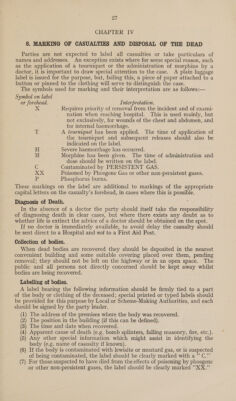
![and the fingers passing over the ribs on either side and pointing towards the ground, but not spread out et tate Rr Bending your body from the knees swing slowly forward sothat the weight of your body is conveyed to your hands directly down- wards. No exertion needed; the necessary pressure is given by the weight of your DOdYy, Pious UR PP Saas Sa or lee es 2 Swing your body slowly backwards to its first position thus removing the weight from your hands which are kept in position a nea 2 Alternate these movements by rhythmic swaying forwards and backwards of your body ; bade lee 2 12, Himes a. MAR se a ee I ten sees i ec GT a ern ae ae 2 The rhythm is: pressure 2 seconds and relaxation 3 seconds =——..... 2 When natural breathing begins regulate the movements of artificial . respiration to correspond with it Ee SE Wrap casualty in blankets and rapidly look for other injuries —.... . 2 Apply strips of lint to burns on hands 63, eciap onal covered with pad of cotton wool and secured by bandage BS If stretcher at once available, load casualty on to stretcher, obtaining assistance from other members of YOUR Partly.) gs Beg eee 2 For loading with two, three or four bearers—correct procedure ——_.......... 4 Decision as to initial disposal (to first aid post by wheeled transport) ...... 2 50 EXAMPLE IT. (a) Information (by card or orally) :— “The casualty is found lying unconscious in the street. He appears to have been struck by falling masonry and to have been driven violently against a handcart.”’ (b) Note for Instructor. The casualty is lying on his right side with his right hip resting against an overturned handcart. He is unconscious, but comes round during the course of the test. Occipital haemorrhage; fractured pelvis; simple fracture right scapula. (c) Marking sheet. - Speak to the patient. .He does not answer = =, 1 Is he breathing? (“ Yes’’) PG ee eee Gr Ge ep be eo! Cy 2 Carefully remove barrow from casualty, and out of the way espe sGos 1 Note possible injury to pelvis : ADRES 2 Note demormrhage back ofhead i. 500 ae a rere 2 Is blood scarlet? (‘‘ Yes”’) Mee 6 SMU Ne Uae a ta ne 1 Spurting? (‘‘ Yes’’) ; Srl. Gaee Character of .Wound °.(% Iicised “fii. se AM OE ahs ee eee ee ] Decide treat as-arterial haemorrhage’) iy 5 ee 2 Apply indirect pressure on occipital artery pressure point sis shcheeiaae Is haemorrhage controlled? (‘‘ Yes ’’) Examine the wound ee Foreign bodies? (‘ No”’) eres 2 Local signs of fracture? (‘“ No’’) cea Fe toate 2 Apply clean dressing GeO Oe tae Oe Ta OS aa ea if Haemorrhage still controlled? (‘‘ Yes” Further examination. Colour face (“ pale ’’) ORME seta ae ] Skin (“cold and clammy * ’) : Me eR Mian ute os ts - 1 Breathing. Slalom (i ee eh TOS Pe ee ene ene eee ] Any blood from nose; ears-or mouth? (WO ye) i easel ean eee 3 Undo tight clothing neck, chest and waist | iy aii ccs, 1 Keep head low and turn on one side sae Rla bak Mei $0 2 Treat shock. Gently wrap da blankets Re ei i ee rata 2 Examine for other injuries, 'Clavicles (normal) ¢- 7° (0) 4 ee 2](https://iiif.wellcomecollection.org/image/b32174767_0026.jp2/full/800%2C/0/default.jpg)
 No text description is available for this image
 No text description is available for this image
 No text description is available for this image