A general system of botany, descriptive and analytical : in two parts ... / by Emm. Le Maout, J. Decaisne ; with 5500 figures by L. Steinheil and A. Riocreux ; translated from the original by Mrs. Hooker ... ; with additions, an appendix on the natural method, and a synopsis of the orders, by J.D. Hooker.
- Date:
- 1873
Licence: Public Domain Mark
Credit: A general system of botany, descriptive and analytical : in two parts ... / by Emm. Le Maout, J. Decaisne ; with 5500 figures by L. Steinheil and A. Riocreux ; translated from the original by Mrs. Hooker ... ; with additions, an appendix on the natural method, and a synopsis of the orders, by J.D. Hooker. Source: Wellcome Collection.
Provider: This material has been provided by the Royal College of Physicians of Edinburgh. The original may be consulted at the Royal College of Physicians of Edinburgh.
22/1088 (page 6)
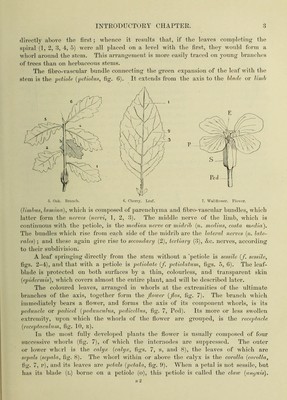
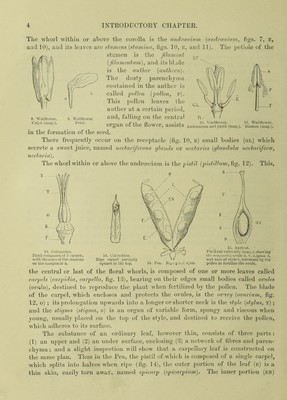
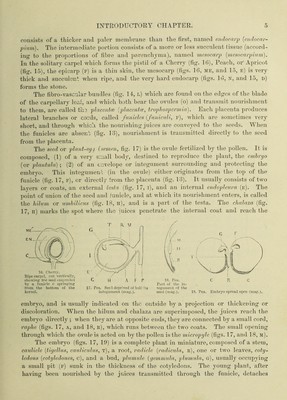
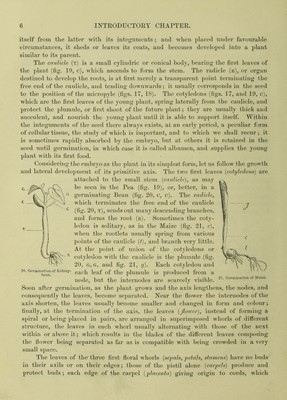
![itself from tlie latter with its integuments ; and when placed under favourable circumstances, it sheds or leaves its coats, and becomes developed into a plant similar to its parent. The caulicle (t) is a small cylindric or conical body, hearing the first leaves of the plant (fig. 19, c), which ascends to form the stem. The radicle (it), or organ destined to develop the roots, is at first merely a transparent point terminating the free end of the caulicle, and tending downwards; it usually corresponds in the seed to the position of the micropyle (figs. 17, 18). The cotyledons (figs. 17, and 19, c), which are the first leaves of the young plant, spring laterally from the caulicle, and protect the plumule, or first shoot of the future plant; they are usually thick and succulent, and nourish the young plant until it is able to support itself. Within the integuments of the seed there always exists, at an early period, a peculiar form of cellular tissue, the study of which is important, and to which we shall recur; it is sometimes rapidly absorbed by the embryo, but at others it is retained in the seed until germination, in which case it is called albumen, and supplies the young- plant with its first food. Considering the emhrj-o as the plant in its simplest form, let us follow the growth and lateral development of its primitive axis. The two first leaves (cotyledons) are attached to the small stem [caulicle), as may be seen in the Pea (fig. 19), or, better, in a germinating Bean (fig. 20, c, c). The radicle, which terminates the free end of the caulicle c (fig. 20, t), sends out many descending branches, and forms the root (r). Sometimes the coty- ledon is solitary, as in the Maize (fig. 21, c), when the rootlets usually spring from various points of the caulicle (t), and branch very little. At the point of union of the cotyledons or p> cotyledon with the caulicle is the plumule (fig. 20, g, g, and fig. 21, g). Each cotyledon and 20. Germination of Kidney- eacp ]eaf 0f the plumule is produced frOIU a node, but the internodes are scarcely visible. 2I-Gclmiliat,on of Ma,ze- Soon after germination, as the plant grows and the axis lengthens, the nodes, and consequently the leaves, become separated. Near the flower the internodes of the axis shorten, the leaves usually become smaller and changed in form and colour; finally, at the termination of the axis, the leaves [flower), instead of forming a spiral or being placed in pairs, are arranged in superimposed whorls of different structure, the leaves in each whorl usually alternating with those of the next within or above it; which results in the blades of the different leaves composing the flower being separated as far as is compatible with being crowded in a very small space. The leaves of the'three first floral whorls (sepals, petals, stamens) have no buds in their axils or on their edges ; those of the pistil alone (carpels) produce and protect buds ; each edge of the carpel (placenta) giving origin to cords, which](https://iiif.wellcomecollection.org/image/b21903463_0022.jp2/full/800%2C/0/default.jpg)