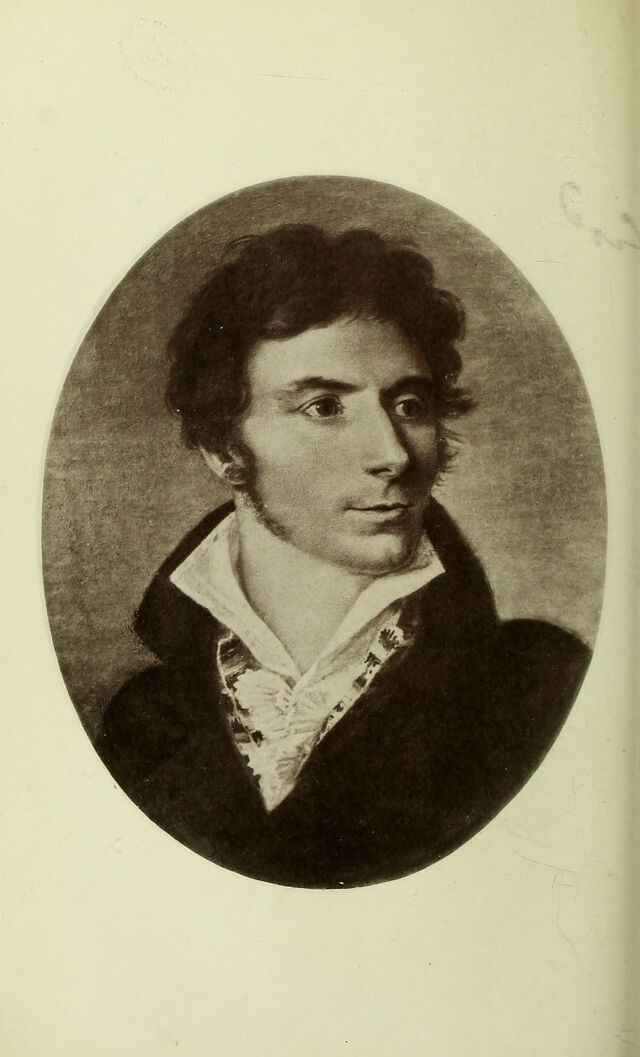
Lorenz Oken : a biographical sketch or In memoriam of the centenary of his birth : read before the fifty-second meeting of the German Association for the Advancement of Science at Baden-Baden, September 20, 1879 / by Alexander Ecker, with explanatory notes, selections from Oken's correspondence and a portrait of the Professor ; from the German by Alfred Tulk.
- Alexander Ecker
- Date:
- 1883
Licence: Public Domain Mark
Credit: Lorenz Oken : a biographical sketch or In memoriam of the centenary of his birth : read before the fifty-second meeting of the German Association for the Advancement of Science at Baden-Baden, September 20, 1879 / by Alexander Ecker, with explanatory notes, selections from Oken's correspondence and a portrait of the Professor ; from the German by Alfred Tulk. Source: Wellcome Collection.
Provider: This material has been provided by The Royal College of Surgeons of England. The original may be consulted at The Royal College of Surgeons of England.
47/212 page 23
![mention of Oken’s name, that in the year 1807 this same doctrine had been “ thrust upon the public in a disorderly and imperfect manner.” If at the present hour there is no occasion to doubt the truth of Goethe’s testimony,’^ it is on the other hand a matter beyond all question that Oken made his discovery in a perfectly independent way; and that to him, too, belongs the special merit of having proved by demonstration the idea, and so intro- duced it into the scientific world. And that, so the whole matter stands, is not to be wondered at, for the thought was floating about, so to speak, “ in the air,” and if neither Oken nor Goethe had hit upon it, some one else assuredly would. In any case, the over-zealous admirers of Goethe have done a great wrong in accusing Oken of plagiarism, and we cannot take it ill of the latter ’ In a letter to Herder’s wife from Venice, dated May 8th, 1790, Goethe tells her “how by the lucky accident of his servant picking up a piece of an animal’s skull in the Jewish cemetery, from off the sands of the Lido, and making some joke upon it, he had made a great step in the elucidation of animal structure, and felt as though he now stood before another portal in Science simply waiting some turn of good luck that should hand him the key to open it with.” “ This great step must surely,” says Ecker, “be the vertebral theory of the skull with which he declares in 1820 that he had been already acquainted for thirty years.” [How far, however, he had succeeded during all that lengthy period in mastering the idea is best told in his own words. He says, “he first of all recognized three vertebrae, viz. the hindermost ones, and then six, but ac- knowledges at the same time that upon attempting to carry out the idea into detail he was unable to arrive at any satisfactory conclusions, and felt himself obliged to leave the whole matter for further inquiry in the hands of confidential friends.” So much for Goethe’s pretensions. As regards the whole question the reader cannot do better than consult the “ Report on the Vertebrate Skeleton,” by Professor Owen, 1847, where, at p. 244, he will find some admirable reasons expressed for regarding Oken in the light of the true and original discoverer.—Tr.]](https://iiif.wellcomecollection.org/image/b22305889_0049.jp2/full/800%2C/0/default.jpg)




 No text description is available for this image
 No text description is available for this image
 No text description is available for this image