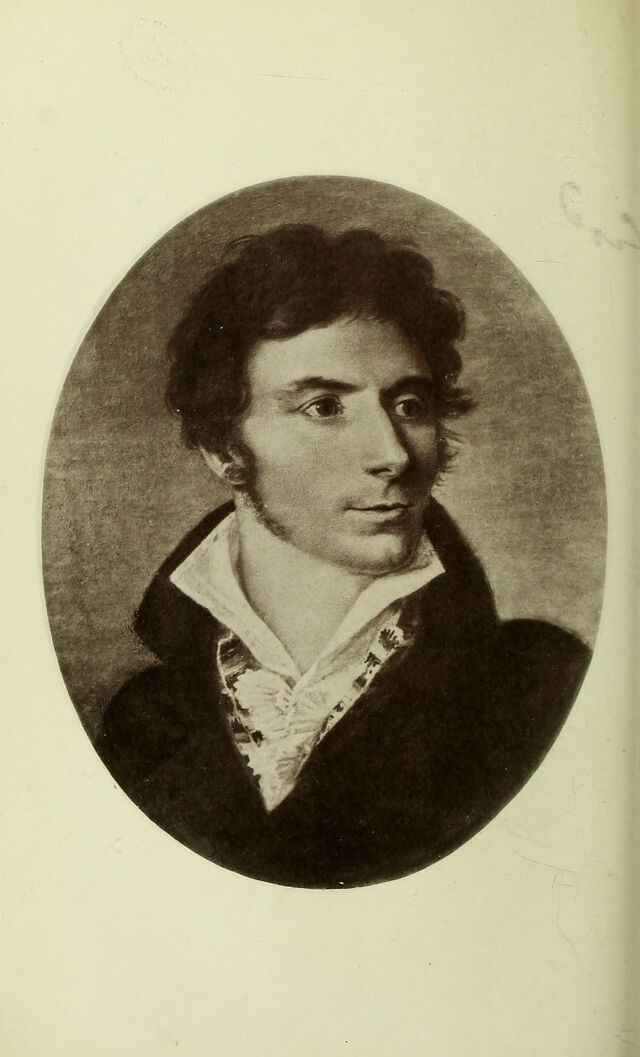
Lorenz Oken : a biographical sketch or In memoriam of the centenary of his birth : read before the fifty-second meeting of the German Association for the Advancement of Science at Baden-Baden, September 20, 1879 / by Alexander Ecker, with explanatory notes, selections from Oken's correspondence and a portrait of the Professor ; from the German by Alfred Tulk.
- Alexander Ecker
- Date:
- 1883
Licence: Public Domain Mark
Credit: Lorenz Oken : a biographical sketch or In memoriam of the centenary of his birth : read before the fifty-second meeting of the German Association for the Advancement of Science at Baden-Baden, September 20, 1879 / by Alexander Ecker, with explanatory notes, selections from Oken's correspondence and a portrait of the Professor ; from the German by Alfred Tulk. Source: Wellcome Collection.
Provider: This material has been provided by The Royal College of Surgeons of England. The original may be consulted at The Royal College of Surgeons of England.
55/212 page 31
![chancellor. Indeed, Oken was politically what is now called or nicknamed “ Grossdeutsch,” that is to say, his kaiser is that of Austria, and was so even in 1848. Despite this, however, had he lived over 1866 and 1870, he would have been one of the trustiest subjects of the kingdom; for above all he was to the very core a German, and not as happens too often nowadays, first of all a party-man and then a patriot.^ * It would carry me too far beyond the limits assigned to this book if I was to insert all that is to be found in Oken’s printed writings. I must there- fore content myself with giving only a few statements that are characteristic of his political views, and for the remainder must recommend to my readers the perusal of Oken’s little treatise as being well adapted to give a true picture of the German patriot. At p. 67 he says, “ It is languages, not political decrees, that separate nations ; their abodes are held apart by mountain chains, but not by rivers.” Again, at p. 68, “Any number of human beings that speak the same language form one people and must be held together by one and the same law : and so it is obvious that it is ihe monarchical form of government alone that cait meet the demands of such an tinity. Any other form than this is a contradiction and cannot subsist,” etc. At p. 132, “ We shall never get the character of being a nation per se until we are one undivided people, and this we shall only be when we have a single master. Now this single master of German posver (not merely of laws, education, institutions, religion, etc.), is none other than the Emperor or kaiser.” “ Our Kaiser must be a military kaiser, and have alone the right of maintaining and summoning together the collective power of the army either for purposes of defence or of war. There should be no such thing as prince’s soldiers, but only emperor’s,” etc. ; and at p. 135, “The kaiser alone is to send forth and receive ambassadors, for he alone has to deal with foreign countries.” What is further said respecting the imperial privileges, such as taxes, charters, postal administration, customs, school-control, police regulations, education, universities, academies, etc., contains much, too, that is worthy of being taken into hearty consideration. [The whole book, curiously enough, as if in anticipation of 1870, con- cludes with a detailed project for erecting a colossal denkmal or monument commemorative of Germany’s liberation, with all her frontier lines restored, as a one and undivided country.—Tr.]](https://iiif.wellcomecollection.org/image/b22305889_0057.jp2/full/800%2C/0/default.jpg)


 No text description is available for this image
 No text description is available for this image
 No text description is available for this image