Hospital construction and management / by Frederic J. Mouat and H. Saxon Snell.
- Date:
- 1889
Licence: Public Domain Mark
Credit: Hospital construction and management / by Frederic J. Mouat and H. Saxon Snell. Source: Wellcome Collection.
Provider: This material has been provided by the Royal College of Physicians of Edinburgh. The original may be consulted at the Royal College of Physicians of Edinburgh.
547/588 page 1
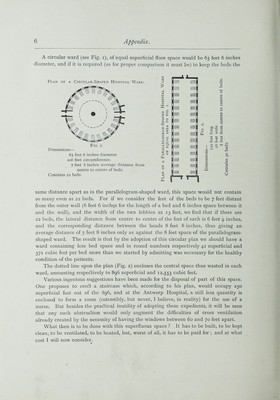
![APPENDIX. CIRCULAR HOSPITAL WARDS. [Excerpt from Vol. VII. of the Transactions of the Sanitary Institute of Great Britain.] By H. Saxon Snell, F.R.I.B.A., Read September 24th 1885, at the Congress of the Institute, held at Leicester. The proposition for constructing hospital sick wards upon what is known as the “ Circular System,” was first made in this country during the latter part of 1878, about the same time that the foundation-stone was being laid in Belgium of a hospital intended to be built upon this principle. The design for this building, the Antwerp Civil Hospital, having received the approval of the Communal Administration of the town, was referred to the consideration of the Council of Public Hygeian at Brussels, but this body strongly condemned the ereCtion of circular wards upon grounds which, now the building is ereCted, would appear to have been correCt. Nevertheless, the work was proceeded with, and the building is now opened and may be inspected by those interested in the question. No other Continental nation has, to my knowledge, considered this new system worthy of imitation, but in England many similar hospitals have been ereCted, and it is, I believe, in contemplation to ereCt others. There is something very fascinating about the conception of a circular ward, and superficial consideration of the question would lead to a belief in the soundness of the arguments advanced in favour of the system ; indeed, I was myself disposed, before critically examining the matter, to allow that its adoption might possibly be productive of some, if not all, the benefits promised by its advocates. This illusion was, however, dispelled when lately I had occasion to study the question in all its aspects for the purposes of a report to a public body prepared to ereCt this class of wards upon my recommendation, and I propose now to show the reasons that led me to the conclusion that parallelogram-shaped sick wards are in every respeCt much more economical, both in first cost and in management, and that no advantage is to be attained by the increased outlay consequent upon the erection of wards of circular shape. My present remarks will be confined to a consideration of the erection of wards for general hospitals, and I do not propose in this paper to deal with the question in its application to fever or other wards for special cases. Nevertheless, I am equally convinced that the circular system as now advocated is wrong in any kind of hospital building, whatever be its special use or locality ; but to deal with the question in its](https://iiif.wellcomecollection.org/image/b21911319_0547.jp2/full/800%2C/0/default.jpg)