Hospital construction and management / by Frederic J. Mouat and H. Saxon Snell.
- Date:
- 1889
Licence: Public Domain Mark
Credit: Hospital construction and management / by Frederic J. Mouat and H. Saxon Snell. Source: Wellcome Collection.
Provider: This material has been provided by the Royal College of Physicians of Edinburgh. The original may be consulted at the Royal College of Physicians of Edinburgh.
556/588 page 10
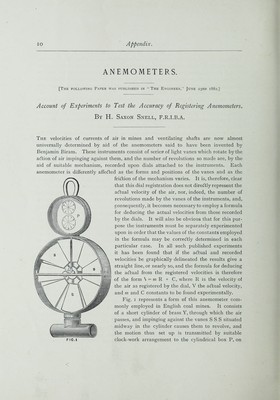
![ANEMOMETERS. [The following Paper was published in “ The Engineer,” June 23RD 1882.] Account of Experiments to Test the Accuracy of Registering Anemometers. By H. Saxon Snell, F.R.I.B.A. The velocities of currents of air in mines and ventilating shafts are now almost universally determined by aid of the anemometers said to have been invented by Benjamin Biram. These instruments consist of series of light vanes which rotate by the aiftion of air impinging against them, and the number of revolutions so made are, by the aid of suitable mechanism, recorded upon dials attached to the instruments. Each anemometer is differently affecfted as the forms and positions of the vanes and as the fridtion of the mechanism varies. It is, therefore, clear that this dial registration does not diredtly represent the adtual velocity of the air, nor, indeed, the number of revolutions made by the vanes of the instruments, and, consequently, it becomes necessary to employ a formula for deducing the actual velocities from those recorded by the dials. It will also be obvious that for this pur- pose the instruments must be separately experimented upon in order that the values of the constants employed in the formula may be corredtly determined in each particular case. In all such published experiments it has been found that if the adtual and recorded velocities be graphically delineated the results give a straight line, or nearly so, and the formula for deducing the adtual from the registered velocities is therefore of the form \ = m R + C, where R is the velocity of the air as registered by the dial, V the adtual velocity, and m and C constants to be found experimentally. Fig. 1 represents a form of this anemometer com- monly employed in English coal mines. It consists of a short cylinder of brass Y, through which the air passes, and impinging against the vanes S S S situated midway in the cylinder causes them to revolve, and the motion thus set up is transmitted by suitable Fic.i clock-work arrangement to the cylindrical box P, on](https://iiif.wellcomecollection.org/image/b21911319_0556.jp2/full/800%2C/0/default.jpg)