On the respiratory changes of the intrathoracic pressure : measured in the mediastinum posterior / By Dr. S.J. Meltzer.
- Samuel James Meltzer
- Date:
- [1892]
Licence: Public Domain Mark
Credit: On the respiratory changes of the intrathoracic pressure : measured in the mediastinum posterior / By Dr. S.J. Meltzer. Source: Wellcome Collection.
Provider: This material has been provided by the Augustus C. Long Health Sciences Library at Columbia University and Columbia University Libraries/Information Services, through the Medical Heritage Library. The original may be consulted at the the Augustus C. Long Health Sciences Library at Columbia University and Columbia University.
31/42 (page 237)
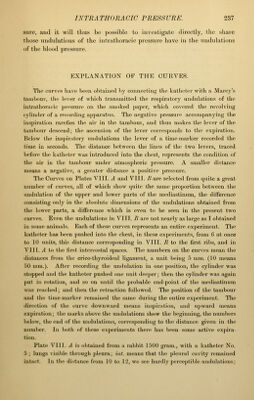
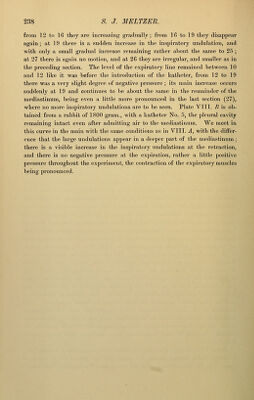
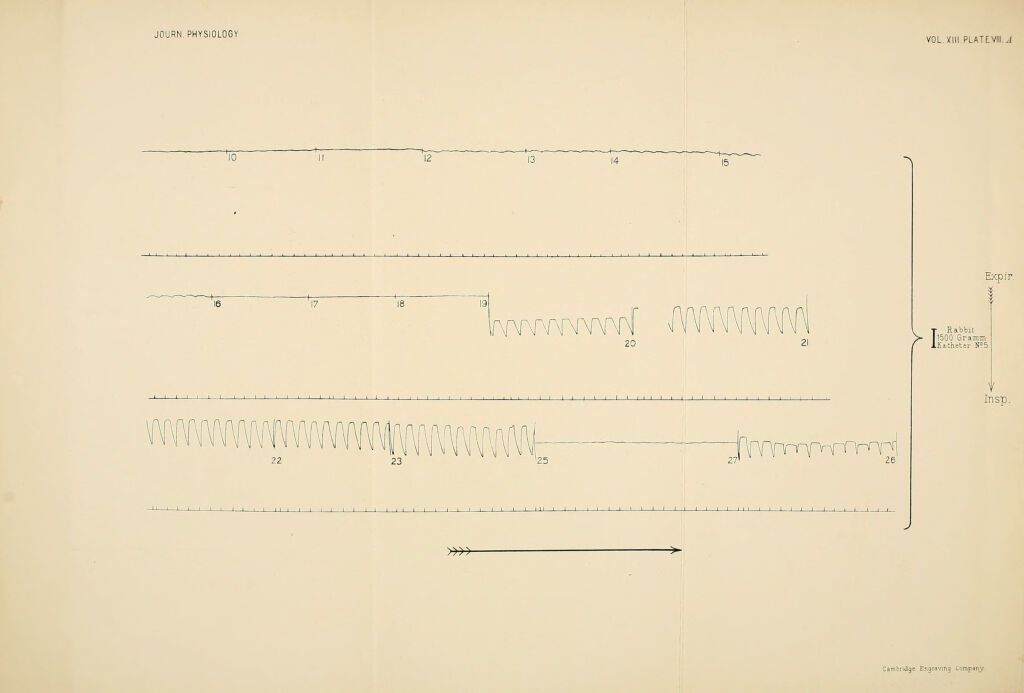
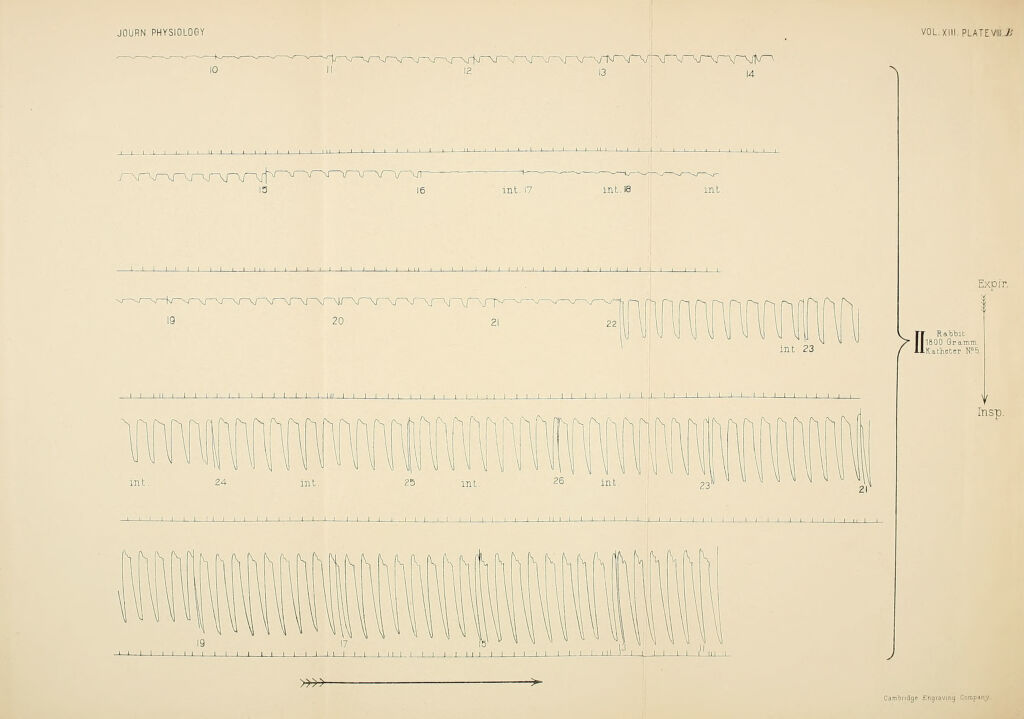
![sure, and it will thus be possible to investigate directly, the share those undulations of the intrathoracic pressure have in the undulations of the blood pressure. EXPLANATION OF THE CURVES. The cnrvps have been obtained by connecting the katheter with a Marey's tanilxiur, the lever of which transmitted the respiratory undulations of the intrathoracic pressure on the smoked jmper, which covered the revolving cylinder of a i-ecording apparatus. The negative pressure accompanying the inspiration iarefies the air in the tambour, and thus makes the lever of the tambour descend; the ascension of the lever corre.sponds to the expiration. Below the inspiratory undulations the lever of a time-marker recorded the time in seconds. The distance between the lines of the two levers, ti'aced l»efore the katheter was introduced into the chest, represents the condition of the air in the tambour under atmospheric pressure. A smaller distance means a negative, a greater di.stance a positive pressure. The Curves on Plates VIII. A and VIII. 7> are selected fi'om quite a great number of curves, all of which show quite the same proj)ortion between the undulation of the upper and lower parts of the mediastinum, the difference consisting only in the absolute dimensions of the undulations obtained from the lower parts, a difference which is even to be seen in the pi-esent two curves. Even the undulations in VIII. J] are not nearly as large as I obtained in some animals. Each of these curves represents an entire experiment. The katheter lias been pushed into the chest, in these experiments, from 6 at once to 10 units, this distance corresponding in VIII. B to the fii'st ribs, and in VIII. A to the fir.st intercostal spaces. The numbers on the curves mean the distances from the crico-thyroideal ligament, a unit being 5 mm. (10 means 50 mm.). After recording the undulation in one position, the cylinder was stopped and the katheter pu.shed one unit deeper; then the cylinder was again put in rotation, and so on until the probable end-point of the mediastinum was reached; and then the retraction followed. The position of the tambour and the time-marker remained the same during the entire experiment. The direction of the curve downward means inspiration, and iq)ward means expiration; the marks above the undulations sliow the beginning, the numbers below, the end of the undulations, corres))onding to the distance given in the numl>er. In both of the.se exj)eriments there has been .some active expira- tion. Plate VIII. A is olitained from a rablnt ir)00 gram., with a katheter No. 5 ; lungs visible through pleura; int. means that the pleural cavity remained intact. In the distance from 10 to 12, we see hardly perceptible undulations;](https://iiif.wellcomecollection.org/image/b21213094_0031.jp2/full/800%2C/0/default.jpg)