The Health Exhibition literature. Vol. XVII. : Special catalogue of the education division. Catalogue of manufactures, decorations and designs. Library catalogue. Catalogue issued by the sanitary bureau of Japan. Catalogue with explanatory notes from the education department of Japan. General outlines of education in Japan.
- International Health Exhibition (1884 : London, England)
- Date:
- 1884
Licence: Public Domain Mark
Credit: The Health Exhibition literature. Vol. XVII. : Special catalogue of the education division. Catalogue of manufactures, decorations and designs. Library catalogue. Catalogue issued by the sanitary bureau of Japan. Catalogue with explanatory notes from the education department of Japan. General outlines of education in Japan. Source: Wellcome Collection.
Provider: This material has been provided by London School of Hygiene & Tropical Medicine Library & Archives Service. The original may be consulted at London School of Hygiene & Tropical Medicine Library & Archives Service.
580/804 (page 560)
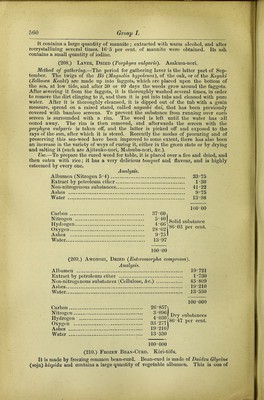
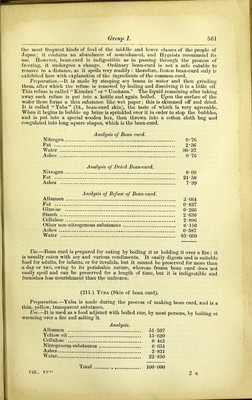
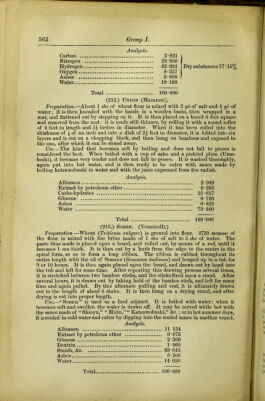
![It contains a large quantity of inannite ; extracted with warm alcohol, and after recrystallizing several times, 16-5 per cent, of mannite were obtained. Its ash contains a small quantity of iodine. (208.) Laver, Dried (Porphyra vulgaris). Asakusa-nori. Method of gathering.—The period for gathering laver is the latter part of Sep- tember. The twigs of the Ho (Magnolia hypoleuea), of the oak, or of the Keyaki (Zelkoiva Keaki) are made up into faggots, which are placed upon the bottom of the sea, at low tide, and after 30 or 40 days the weeds grow around the faggots. After severing it from the faggots, it is thoroughly washed several times, in order to remove the dirt clinging to it, and then it is put into tubs and cleaned with pure water. After it is thoroughly cleansed, it is dipped out of the tub with a grain measure, spread on a raised stand, called nagashi dai, that has been previously covered with bamboo screens. To prevent the substance from running over each screen is surrounded with a rim. The weed is left until the water has all oozed away. The rim is then removed, and afterwards the screen with the porphyra vulgaris is taken off, and the latter is picked off and exposed to the rays of the sun, after which it is stored. Recently the modes of procuring and of preserving this sea-weed have been improved to some extent, there has also been an increase in the variety of ways of curing it, either in the green state or by drying and salting it (such are Ajitsuke-nori, Matsuba-nori, &c.). Use.—To prepare the cured weed for table, it is placed over a fire and dried, and then eaten with rice; it has a very delicious bouquet and flavour, and is highly esteemed by every one. Analysis. Albumen (Nitrogen 5 ■ 4) 33‘75 Extract by petroleum ether 1-30 Non-nitrogenous substances 41-22 Ashes 9-75 Water 13 98 Carbon ... Nitrogen Hydiogen Oxygen... Ashes ... Water 100-00 37-60j ?, [ Solid substance 2g.62(8b03 per cent. 9-75l 13-97 100-00 (209.) Awonor], Dried (Enteromorpha compressa). Analysis. Albumen 19-721 Extract by petroleum ether 1-730 Non-nitrogenous substances (Cellulose, &c.) 45-809 Ashes 19-210 Water 13-530 100-000 26-8571 f ?qn(D>y substances 3^^,277(86-47 per cent. 19-210) 13-530 100-000 (210.) Frozen Bean-Cdrd. Kori-tofu. It is made by freezing common bean-curd. Bean-curd is made of Daidzu Glycine (soja) hispida and contains a large quantity of vegetable albumen. This is one of Carbon.... Nitrogen . Hydrogen Oxygen . Ashes .... Water ....](https://iiif.wellcomecollection.org/image/b28045312_0580.jp2/full/800%2C/0/default.jpg)