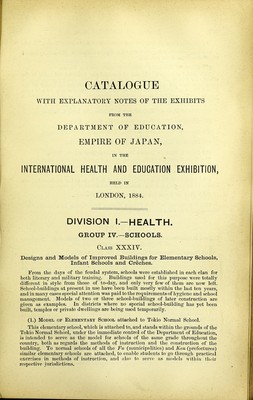
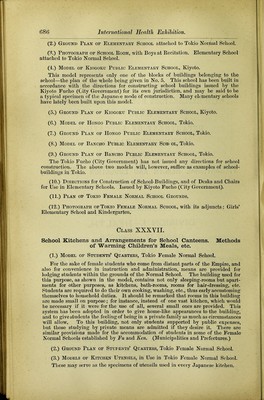
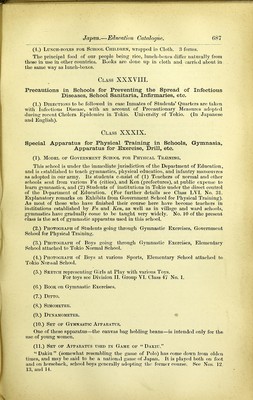
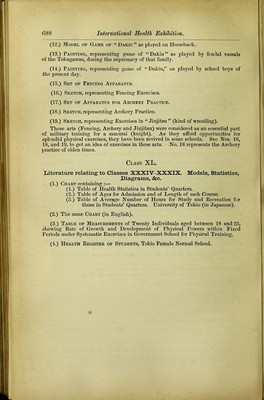
The Health Exhibition literature. Vol. XVII. : Special catalogue of the education division. Catalogue of manufactures, decorations and designs. Library catalogue. Catalogue issued by the sanitary bureau of Japan. Catalogue with explanatory notes from the education department of Japan. General outlines of education in Japan.
- International Health Exhibition (1884 : London, England)
- Date:
- 1884
Licence: Public Domain Mark
Credit: The Health Exhibition literature. Vol. XVII. : Special catalogue of the education division. Catalogue of manufactures, decorations and designs. Library catalogue. Catalogue issued by the sanitary bureau of Japan. Catalogue with explanatory notes from the education department of Japan. General outlines of education in Japan. Source: Wellcome Collection.
Provider: This material has been provided by London School of Hygiene & Tropical Medicine Library & Archives Service. The original may be consulted at London School of Hygiene & Tropical Medicine Library & Archives Service.
720/804 (page 690)
![(9.) Charts for Moral and Object Teaching, Kindergarten attached to Tokio Female Normal School. These are specimens of charts used to illustrate, and thus to impress more vividly, stories which are calculated either to arouse children’s moral feelings, or to add to their store of positive knowledge. Thus, the first chart illustrates the story of certain monkeys in the province of Shinano who were very affectionate to their mother-monkey, and is intended to bring out the duty of filial piety. The second chart gives the story of the famous penman, Ono-no-T6foo. Having been greatly impressed by seeing a frog after repeated failures, and by persistent efibrts, succeed in jumping up to a willow branch, this person took to studying writing, and by applying himself strenuously, became finally to be one of the three best penmen Japan has ever known. This, it need hardly be said, is intended to impress the necessity of patience and diligence. While these illustrate moral stories, the third and fourth charts represent respectively the rearing of silk-worms and the process of weaving, and are used to teach the first rudiments of Domestic Economy and Natural History. D.—Specimens of Work done in Kindergarten. (10-11.) Specimens op Work done in Kindergarten attached to Tokio Female Normal School. (1 Box and 1 Framed Piece.) These have been devised more or less by the children themselves, (12-13.) Specimens op Work done in Kindergarten attached to Sakurai Female School (private), Tokio. (1 Box and 1 Portfolio.) (14-15.) Specimens op Work done in Kindergarten attached to K6t6 Public Female School, Tokio. (2 Portfolios.) Class XLVIII. Elementary Schools. In schools of feudal times no chairs were used, scholars squatted on the matted floor and used very low tables. As desks and chairs are to be preferred, from the point of hygiene and school-management, they have now replaced the low tables in almost every school, and considerable attention is also being paid to their improve- ments. The courses of study have undergone equally great changes. While morals and writing were the chief topics of study, there are taught now, besides morals, reading, writing, and arithmetic, other branches like geography, physics, chemistry, and natural history even in Elementary Schools. This has naturally greatly increased the number of school text-books. The exhibits placed in this class will give an idea of the apparatus, fittings, text-books, &c., now in use in our Elementary Schools. A.—Apparatus and Fittings. (].) Desk for use in Elementary School attached to Tokio Normal School. (2.) Outfit op Elementary School Pupil, Elementary School attached to Tokio Normal School. (8 articles.) An abacus is here included, as rapid methods of calculation by that instrument are taught. The copy-book that requires no ink but water only is one of the most convenient of recent inventions. As our children have to acquire difficult Chinese characters besides the forty-eight letters of the Japanese syllabary, the task before them is not to be compared with the comparatively easy one of learning an alphabet of only twenty-six letters. On this account, more hours are given to writing in our schools than is the case in those of Europe or America. Several exhibits following are apparatus for writing. (3.) Box OF Ink-.'TONe for Indian Ink with Accessories, Elementary School attached to Tokio Normal School.](https://iiif.wellcomecollection.org/image/b28045312_0720.jp2/full/800%2C/0/default.jpg)