Volume 182402
Typographia: or the printers' instructor, including an account of the origin of printing. With biographical notices of the printers of England, from Caxton to the close of the sixteenth century: a series of ancient and modern alphabets, and Domesday characters: together with an elucidation of every subject connected with the art / By J. Johnson, printer.
- John Johnson
- Date:
- 1824
Licence: Public Domain Mark
Credit: Typographia: or the printers' instructor, including an account of the origin of printing. With biographical notices of the printers of England, from Caxton to the close of the sixteenth century: a series of ancient and modern alphabets, and Domesday characters: together with an elucidation of every subject connected with the art / By J. Johnson, printer. Source: Wellcome Collection.
67/692 (page 47)
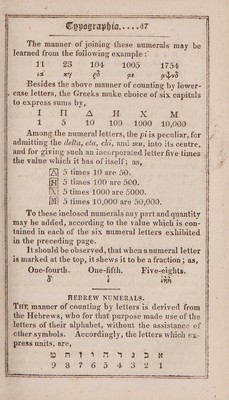
![_— The manner of joining these numerals may be learned from the following example 11 23, 104 1005 1754 1a xy eo ge 6. ahd case letters, the Greeks make choice of six capitals to express sums by, I II van H x M 1 5 10 100 1000 10,000 Among the numeral letters, the pi is peculiar, for admitting the delta, eta, chi, and mu, into its centre, [Al 5 times 10 are 50, fy] 5 times 100 are 500. fl 5 times 1000 are 5000. [M! 5 times 10,000 are 50,000. To these inclosed numerals any part and quantity in the preceding page. Itshould be observed, that when a numeral letter One-fourth. One-fifth. Five-eights. e é enn AREBREW NUMERALS. THE manner of counting by letters is derived from the Hebrews, who for that purpose made use of the cther symbols. Accordingly, the letters which ex- press units, are, LST Coad ie ie pai lela fae SBN AL Dr PST S| BS By Fae ae](https://iiif.wellcomecollection.org/image/b22019145_0002_0067.jp2/full/800%2C/0/default.jpg)