Volume 182402
Typographia: or the printers' instructor, including an account of the origin of printing. With biographical notices of the printers of England, from Caxton to the close of the sixteenth century: a series of ancient and modern alphabets, and Domesday characters: together with an elucidation of every subject connected with the art / By J. Johnson, printer.
- John Johnson
- Date:
- 1824
Licence: Public Domain Mark
Credit: Typographia: or the printers' instructor, including an account of the origin of printing. With biographical notices of the printers of England, from Caxton to the close of the sixteenth century: a series of ancient and modern alphabets, and Domesday characters: together with an elucidation of every subject connected with the art / By J. Johnson, printer. Source: Wellcome Collection.
69/692 (page 49)
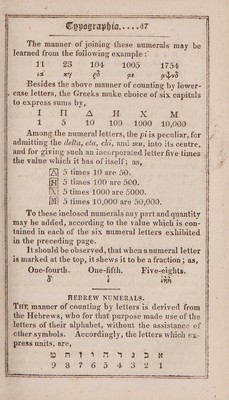
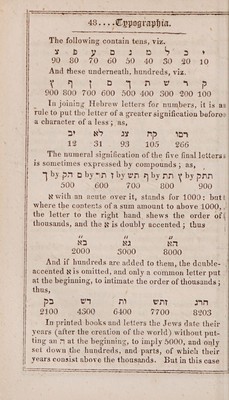
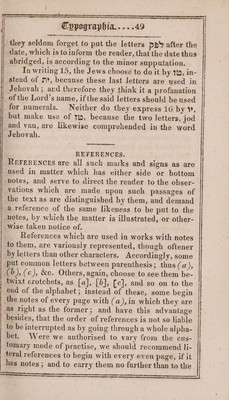
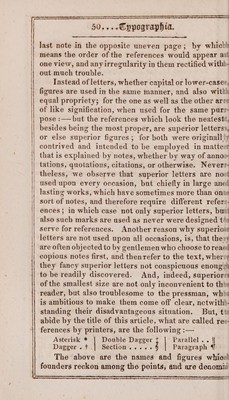
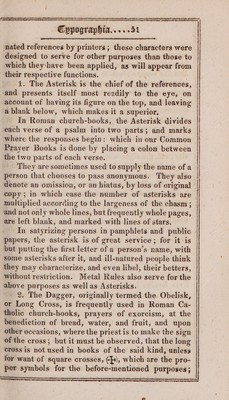
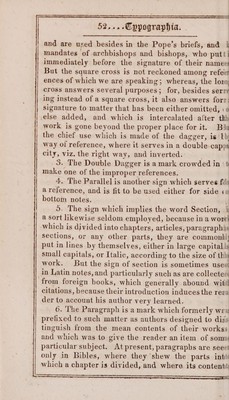
![they seldom forget to put the letters pb after the date, which is to inform the reader, that the date thus: abridged, is according to the minor supputation. In writing 15, the Jews choose to do it by 7%, in- stead of m», because these last letters are used in Jehovah ; ard therefore they think it a profanation of the Lord’s name, if the said letters should be used for numerals. Neither do they express 16 by ¥, but make use of 3%, because the two letters, jod _and vau, are likewise comprehended in the word Jehovah. ; REFERENCES. : REFERENCES are all such marks and signs as are used in matter which has either side or bottom notes, and serve to direct the reader to the obser- vations which are made upon such passages of the text as are distinguished by them, and demand | a reference of the same likeness to be put to the notes, by which the matter is illustrated, or other- wise taken notice of. References which are used in works with notes to them, are variously represented, though oftener by letters than other characters, Accordingly, some put common letters between parenthesis; thus (a), (b), (c), &c. Others, again, choose to see them be- | twixt crotchets, as [a], [0], {c], and so on to the end of the alphabet; instead of these, some begin the notes of every page with (a), in which they are as right as the former; and have this advantage besides, that the order of references is not so liable to be interrupted as by going through a whole alpha- bet. Were we authorised to vary from the cus- tomary mode of practise, we should recommend li- | teral references to begin with every even page, if it has notes; and to carry them no further than to the](https://iiif.wellcomecollection.org/image/b22019145_0002_0069.jp2/full/800%2C/0/default.jpg)