On the sensations of tone as a physiological basis for the theory of music / by Hermann L.F. Helmholtz ; translated, thoroughly revised and corrected, rendered conformable to the 4th (and last) German edition of 1877, with numerous additional notes and a new additional appendix bringing down information to 1885, and especially adapted to the use of musical students, by Alexander J. Ellis.
- Hermann von Helmholtz
- Date:
- 1895
Licence: Public Domain Mark
Credit: On the sensations of tone as a physiological basis for the theory of music / by Hermann L.F. Helmholtz ; translated, thoroughly revised and corrected, rendered conformable to the 4th (and last) German edition of 1877, with numerous additional notes and a new additional appendix bringing down information to 1885, and especially adapted to the use of musical students, by Alexander J. Ellis. Source: Wellcome Collection.
12/604
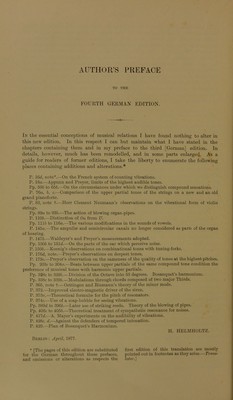
![TO THE FOURTH GERMAN EDITION. In the essential conceptions of musical relations I have found nothing to alter in this new edition. In this respect I can but maintain what I have stated in the chapters containing them and in my preface to the third [German] edition. In details, however, much has been remodelled, and in some parts enlarged. As a guide for readers of former editions, I take the liberty to enumerate the following places containing additions and alterations.* P. 16d, note*.-—On the French System of counting vibrations. P. 18«.—Appunn and Preyer, limits of the highest audible tones. Pp. 596 to 656.—On the circumstances under which we distinguish compound sensations. P. 76«, 6, c.—Comparison of the upper partial tones of the strings on a new and an old grand pianoforte. P. 83, note +.—Herr Clement Neumann’s observations on the vibrational form of violin strings. Pp. 89« to 936.—The action of blowing organ-pipes. P. 1106.—Distinction of Ou from U. Pp. 1116 to 116«.—The various modifications in the sounds of vowels. P. 145«.—The ampullse and semicircular canals no longer considered as parts of the organ of hearing. P. 1476.—Waldeyer’s and Preyer’s measurements adopted. Pp. 1506 to 151d.—On the parts of the ear which perceive noise. P. 1596.—Koenig’s observations on combinational tones with tuning-forks. P. 176<7, note.—Preyer’s observations on deepest tones. P. 179c.—Preyer’s Observation on the sameness of the quality of tones at the highest pitches. Pp. 203c to 204«.—Beats between upper partials of the same compound tone condition the preference of musical tones with harmonic upper partials. Pp. 328c to 3296.—Division of the Octave into 53 degrees. Bosanquet’s harmonium. Pp. 338c to 3396.—Modulations through chords composed of two major Thirds. P. 365, note +.—Oettingen and Riemann’s theory of the minor mode. P. 372.—Improved electro-magnetic driver of the siren. P. 373«.—Theoretical formulse for the pitch of resonators. P. 374c.—Use of a soap-bubble for seeing vibrations. Pp. 389(6 to 3966.—Later use of striking reeds. Theory of the blowing of pipes. Pp. 403c to 4056.—Theoretical treatment of sympathetic resonance for noises. P. 417d.—A. Mayer’s experiments on the audibility of vibrations. P. 428c. d.—Against the defenders of tempered intonation. P. 429.—Plan of Bosanquet’s Harmonium. H. HELMHOLTZ. Berlin : April, 1877. * [The pages of this edition are substituted first edition of this translation are mostly for the German throughout theso profaces, pointed out in footnotes as they arise.—Trans- and omissions or alterations as respects the Icdor.]](https://iiif.wellcomecollection.org/image/b28141532_0012.jp2/full/800%2C/0/default.jpg)